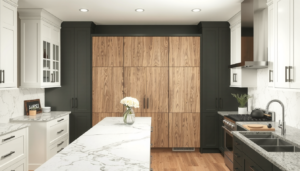
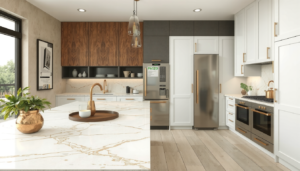
If you’ve been looking at kitchen ideas recently, you’ve probably seen this combination come up quite a bit — Taj Mahal quartzite with white cabinets.
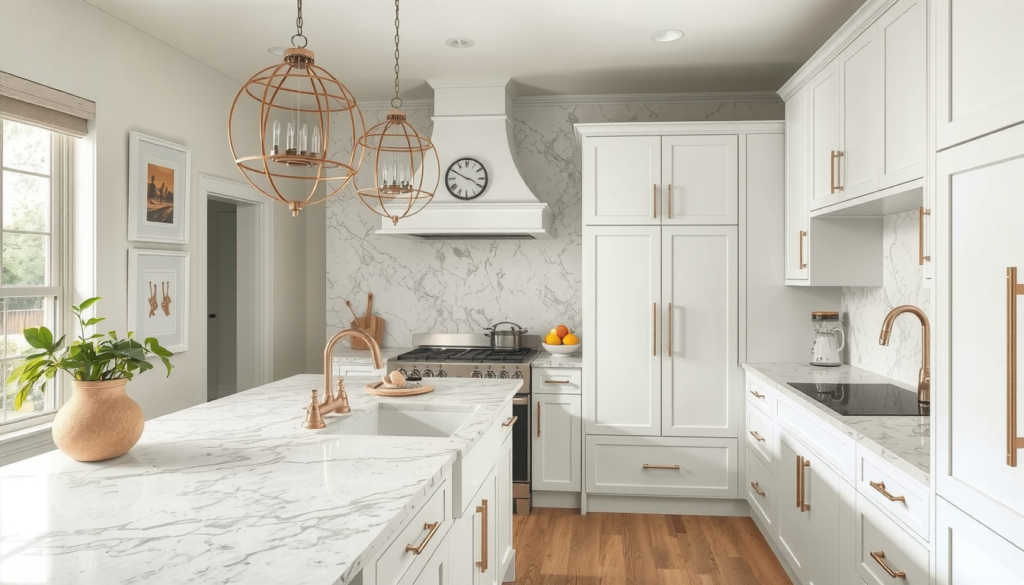
I recommend this pairing quite a bit in real projects. White cabinetry keeps things clean and flexible, while Taj Mahal brings in just enough warmth and variation, so the space doesn’t end up feeling flat or overly “all-white.”
Below I’ll walk through why this pairing works so well, and a few layout ideas that tend to bring out the best in it. I’ll also touch on some smaller details — things like hardware and finishes — that usually make a bigger difference than people expect.
Key Takeaways
- Always in Style: White cabinets act as a neutral base, which makes it much easier to highlight materials like Taj Mahal quartzite without the space feeling busy.
- Material Advantage: Taj Mahal gives you a marble-like look, but holds up much better in daily use — especially if you’re worried about scratches or etching.
- Layout Matters: How you place the countertops makes a big difference. In most cases, layouts like an L-shape with an island or a U-shape give the stone enough visibility to actually stand out.
- Cabinet Style: Shaker, flat-panel, and raised-panel all work here — the choice really depends on whether you want the space to lean more modern or more traditional.
- Hardware Choice: Finishes like champagne bronze or matte black help tie everything together, especially when you’re trying to pick up the warmer tones in the stone.
Enduring Charm: Key Benefits of White Cabinets
White cabinets are more than a gimmick. They’re a safe starting point in most kitchen designs, especially if you’re planning to build around a statement countertop. There are a few practical reasons they continue to show up in so many kitchens, even now. Think of white cabinets as a backdrop — they don’t compete visually, which makes the veining and color variation in Taj Mahal stand out much more.
Here are the key advantages of choosing white cabinetry:
- Always be in Fashion: White cabinets will never be out of style. They are very adaptable and can work with an array of designs. This includes a range of styles, from rustic farmhouse to sleek, modern condos. This is a very good reason to choose them as a longstanding investment.
- Illuminates and Expands: Light reflects off of white surfaces. In smaller kitchens, this makes a noticeable difference — the room feels brighter, and visually a bit more open. They also make it more inviting and create a feeling of an open and airy space.
- Independent Decoration: A clear, white background lets other design elements be the focus. The highlight of the show will undoubtedly be your eye-catching Taj Mahal countertops. Their subtle veining and warm colors weaving through the surface will definitely make an impression.
- High Resale Value: Clean, bright, and modern kitchens are one of the main selling points for a home. White kitchens attract the majority of potential buyers’ interest. Thus, you can significantly raise your home’s market price.
The Perfect Combination: White Cabinets and Taj Mahal Quartzite
What really makes this combination work is the quartzite itself. It softens the crispness of white cabinetry. Without it, an all-white kitchen can feel a bit cold — Taj Mahal brings in that missing warmth.
Taj Mahal quartzite is a perfect stone for warm modern light gray and creamy beige veining. Those subtle undertones matter more than people expect. Without them, an all-white kitchen can start to feel a bit cold — this is what keeps it balanced. The effect is an inviting and dimensional space.
A lot of people prefer the luxurious slender look of marble, but they are afraid to maintain it. It’s a practical way to get that marble look without taking on the same level of maintenance. You get the look of marble but with the superior hardness and durability of quartzite. Quartzite ranks about a 7 on the Mohs hardness scale, making it extremely resistant to scratches and damages. Marble on the other hand is much softer. To find out more, you might be interested in understanding the properties of natural quartzite.
The eye-catching veining of Taj Mahal gives each slab a unique touch. The variations come with mild, fluid color waves in some slabs while others feature bolder, spectacular patterns. This empowers you to make a choice that fits perfectly with the energy and design of your kitchen. Such a custom choice is what makes taj mahal countertops with white cabinets so amazing.
5 Kitchen Layouts That Showcase Taj Mahal and White Cabinets
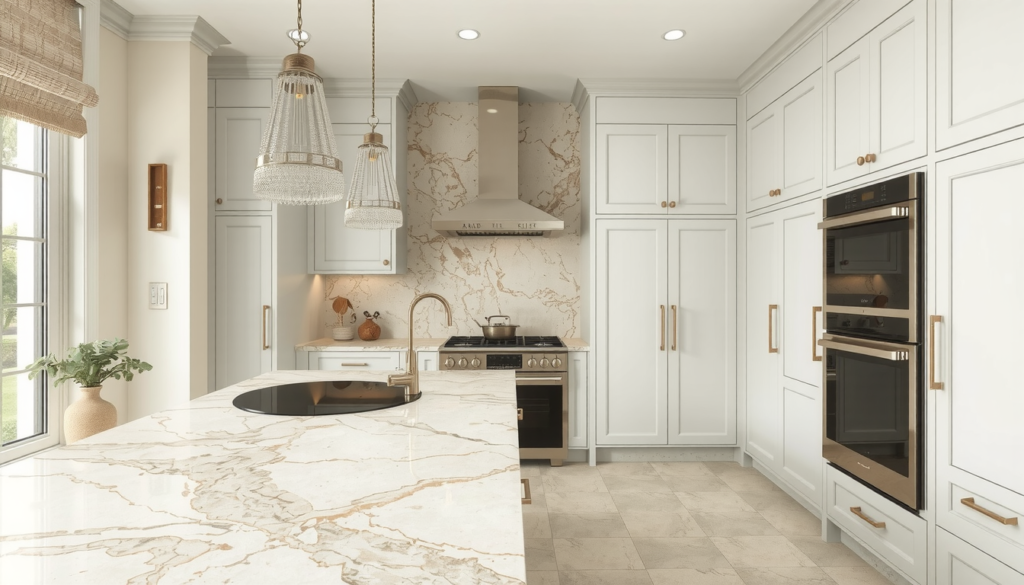
Choosing the right plan is essential for maximizing the fine materials you have. The arrangement of your kitchen is a vital feature for both its function and style, as stated in classic kitchen layouts. The layouts below are the ones I see working best with this combination in real projects.
The U-Shaped Kitchen: Maximizing Countertop Views
A U-shaped kitchen is formed with three walls. This usually gives you longer, uninterrupted countertop runs, which helps show the stone more clearly. One advantage here is you get long, continuous runs of countertop, which really helps show off the natural pattern in the stone. The visual flow of the stone draws the eye in a circular motion around the room. Under-cabinet LED lighting can help highlight the warm texture of the stone.
The L-Shaped Kitchen with an Island: The Perfect Centerpiece
The L-shaped model is one of the most trendy and practical types. But augmenting it with an island not only turns it into a social hub but also makes the design powerful. You can have the island as the focal point by taking a single slab of Taj Mahal quartzite with a big size. This will show the stone’s pattern uninterrupted. In the case of a more luxurious visual effect, opt for a waterfall edge. Here the top surface of the island flows down the sides to the floor with the stone continuing.
The Galley Kitchen: Creating Linear Elegance
Galley kitchens are linear and have two rows of parallel cabinets and countertops. The layout feels more streamlined, especially when you keep the palette simple. The combination of crisp white cabinets with the warm Taj Mahal quartzite counter creates an uncramped space that would otherwise be narrow. To add even more appeal, consider the use of a full-height quartzite backsplash as an accent wall on one of the main walls.
The One-Wall Kitchen: Sleek and Minimalist
The perfect one-wall kitchen for small homes, lofts, or open-living spaces delivers functionality in the least amount of space. The design highlights the materials you select. A white cabinet with a smooth line of quartzite countertops creates a clean, uncluttered, and timeless look. The space feels deliberate and high-end.
The Peninsula Kitchen: Defining the Space
A peninsula kitchen is a twisted version of an L-shape. However, it has an arm-like attachment that sticks out into the room. The inclusion of a peninsula is a wonderful way to not only define the kitchen area but also add extra seating and prep space in an open floor plan. The Taj Mahal quartzite is an excellent introduction here. The beautiful and useful breakfast bar becomes the focal point that naturally draws people together.
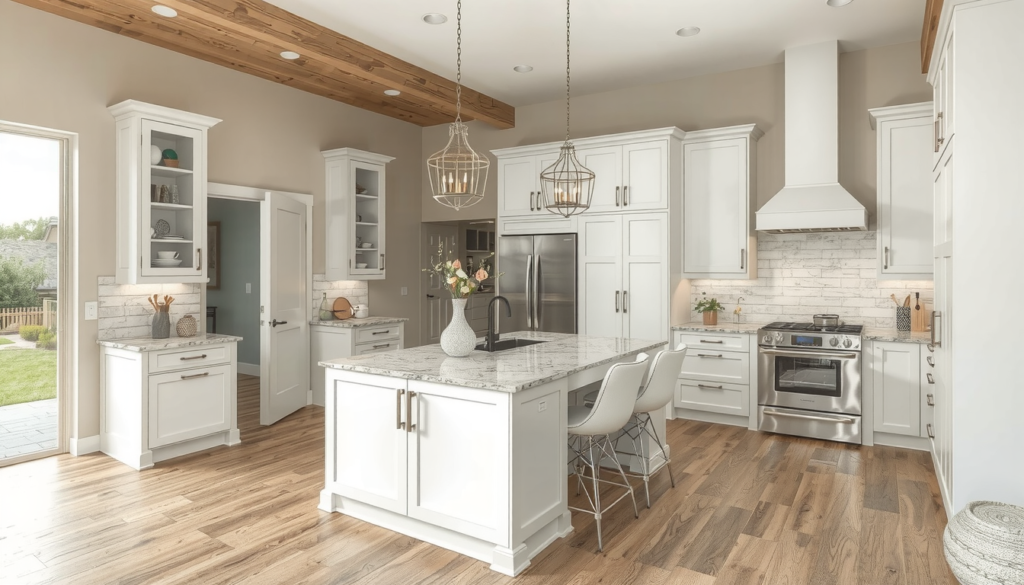
Perfecting the Look: Cabinet Door Style Recommendations
After you determine the layout, the subsequent step will be the selection of the style of the cabinet door. This choice will define the full look of your kitchen. The style that goes right with the soft elegance of Taj Mahal quartzite with white cabinets will be the best.
For a Modern & Sleek Kitchen
If you’re going for a cleaner, more modern look, flat-panel doors usually work best. Their simple, plain surface puts all the focus on the beautiful movement and color within the Taj Mahal quartzite. Naturally, a stripped-down design like that enables the stone to take center stage in your kitchen.
For a Traditional & Elegant Kitchen
If you prefer a more classic and formal style, raised-panel doors work well if you’re aiming for a more traditional, detailed look. These ornate edges, in addition to the dimensional profile, give off a look of classic elegance. This feature combines beautifully with the luxe quartzite feel. The look is rich and timeless.
For a Transitional & Versatile Kitchen
Shaker is still the most commonly used option in my experience — it sits comfortably between modern and traditional, and it’s quite easy to see why. Their frame-and-panel design is simple but effective and provides a good link between traditional and modern styles. Shaker doors are our go-to choice for transitional designs. The linear shape does not get in the way of the veining in the stone, while at the same time it provides more structure rather than a simple flat panel. Thus, they are the perfect partner for Taj Mahal quartzite.
The Finishing Touches: Hardware Pairing Suggestions
Cabinet hardware is basically the jewelry of the kitchen. It is a tiny detail yet it makes a big difference in the overall outcome. Based on our design projects, these finishes tend to work particularly well with Taj Mahal quartzite and white cabinets.
- Champagne Bronze or Satin Brass: This is usually my first recommendation for this combo. Warm and soft golden tones of these finishes highlight the creamy beige and gold flecks in the Taj Mahal quartzite. The effect is a unified, warm, and a warmer, more cohesive look overall throughout the room.
- Matte Black: For a modern twist, matte black is the best option. Matte black works well if you want a bit more contrast — especially in kitchens that already have darker accents. This contrast creates an element of graphics. On the other hand, it grounds the whole design and works together with any darker gray or black specks that may occur in the quartzite.
- Polished Nickel: If you are really after a classic and timeless form, polished nickel is an excellent choice. This finish has a warmer undertone than chrome, which is not as cold. It adds a touch of shiny elegance without outweighing the stone itself.
- Oil-Rubbed Bronze: For a rustic, Tuscan, or traditional look, think of oil-rubbed bronze. The deep, dark finish presents a good contrast with white cabinets. It can also flow with darker wooden floorings or any other indigenous features in your home.
It’s one of those combinations that tends to hold up over time — both visually and in day-to-day use. If you get the details right, it’s a setup you’re unlikely to get tired of anytime soon. With the help of these tips, you can create a perfect kitchen tailored to your style and needs.
Frequently Asked Questions (FAQ)
Is Taj Mahal a granite or a quartzite?
Taj Mahal is a true quartzite. It’s a natural stone formed from sandstone under heat and pressure, which is why it’s much harder than it looks. That’s also why it tends to be more durable than it looks, often even harder than granite in day-to-day use.
What color backsplash goes with Taj Mahal quartzite and white cabinets?
To achieve a clean and high-end look, the best choice is to use a Taj Mahal quartzite slab for the backsplash. Other options are a simple white or cream subway tile, which will not distract the viewer from the countertops. A neutral toned textured ceramic tile would also work well or a subtle mosaic that gathers colors from the stone’s veining.
Does Taj Mahal quartzite stain easily?
With proper sealing, Taj Mahal quartzite shows very little staining to deal with. The dense structure helps to block liquids from penetrating into the stone. But, it is still a porous natural stone, which is the reason why you should wipe spills immediately after they happen. Acidic spills like wine, coffee, or lemon juice need to be wiped up quickly to protect the stone and its sealant.
What paint colors work well with white cabinets and Taj Mahal countertops?
To echo the warm hues, you can choose warm off-whites, soft greiges (a mix of grey and beige), or muted earthy greens or blues. Some very popular paint colors that are used are Benjamin Moore’s “Revere Pewter” and Sherwin-Williams’ “Agreeable Gray.” They help create a cohesive and inviting atmosphere.
How do I clean Taj Mahal quartzite countertops?
For the day-to-day cleaning, all you need is a soft cloth, warm water, and a few drops of a pH-neutral cleaner or mild dish soap. It’s important to avoid using rough sponges, harsh chemical cleaners, bleach, or acid products. These can reduce the lifespan of the sealer and possibly damage the surface of the stone as well.