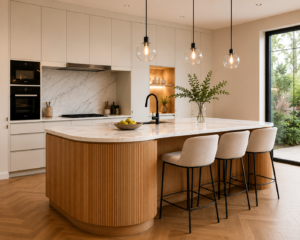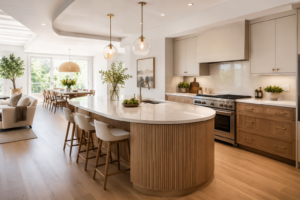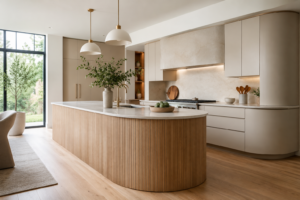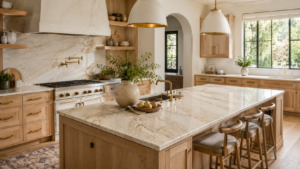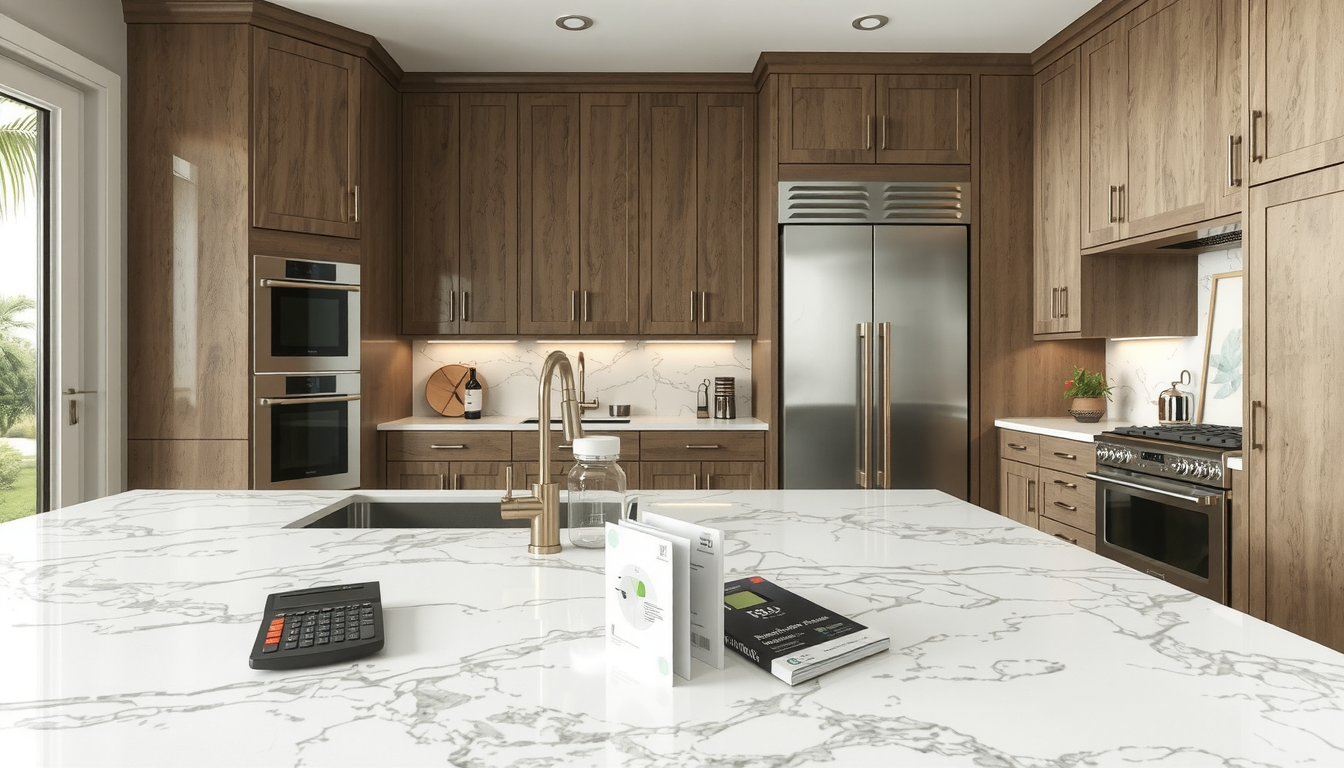
If you’re planning a kitchen upgrade in 2026 and want something that feels refined but not overly flashy, Taj Mahal quartzite is likely already on your shortlist. Its soft tones and subtle veining give it that quiet, high-end look. The real question most homeowners end up asking is pretty simple: how expensive is Taj Mahal quartzite, really?
Key Points
- Very Costly: Taj Mahal quartzite sits firmly in the high-end range. In 2026, installed costs typically fall between $135 and $250+ per square foot, depending on the project.
- Budget Allocation Matters More Than You Think: You can spend money on a costly countertop by adjusting the cost of other kitchen parts. Focus mainly on cabinetry when adjusting your budget.
- Cabinet Strategy: One practical way to make room in your budget is to be more flexible with cabinet choices.
- Quartz vs. Quartzite: Engineered quartz imitations give the same appearance but are cheaper at ($90-$130/sq. ft.). They do not need sealing. But the fact is, engineered quartz can look similar, but it doesn’t have the same natural depth or variation.
- Value Over Time: A kitchen finished with Taj Mahal quartzite can hold its value well over time, thanks to its durability and timeless look.
Is Taj Mahal Quartzite Expensive? A Quick Answer
Yes — Taj Mahal quartzite is considered a premium countertop material, and it sits at the higher end of the natural stone market.
In 2026, installed costs typically land somewhere between $135 and $250+ per square foot. Pricing can vary quite a bit depending on your location, the specific slab you choose, and the fabricator you work with.
For most homeowners, it’s a significant line item in the overall kitchen budget.
That can feel like a big number at first. However, the countertop is just one component of the entire undertaking. The key is knowing where to balance the budget. The main focus will be on budget balance. Most of that comes down to how you handle the rest of the kitchen — especially the cabinetry.
Detailed Cost Description
It helps to understand where the cost actually comes from. The Taj Mahal quartzite price comes due to different factors. The pricing reflects everything from quarrying the stone to getting it installed in your kitchen.
Material vs. Installed Cost
The total cost usually comes down to two parts:
First, the slab itself, and second, the fabrication and installation.
Here is a simple breakdown of the taj mahal quartzite cost:
Cost Component | Typical Price Range (per sq. ft.) | What it Covers |
Raw Slab Material | $90 – $150+ | The actual stone slab that comes from a quarry or a supplier. |
Fabrication & Installation | $45 – $100+ | Templating, cutting, edge profiling, sink cutouts, delivery, and professional installation. |
Total Installed Cost | $135 – $250+ | The total cost covering all that you need to pay. |
Main Factors Affecting Pricing
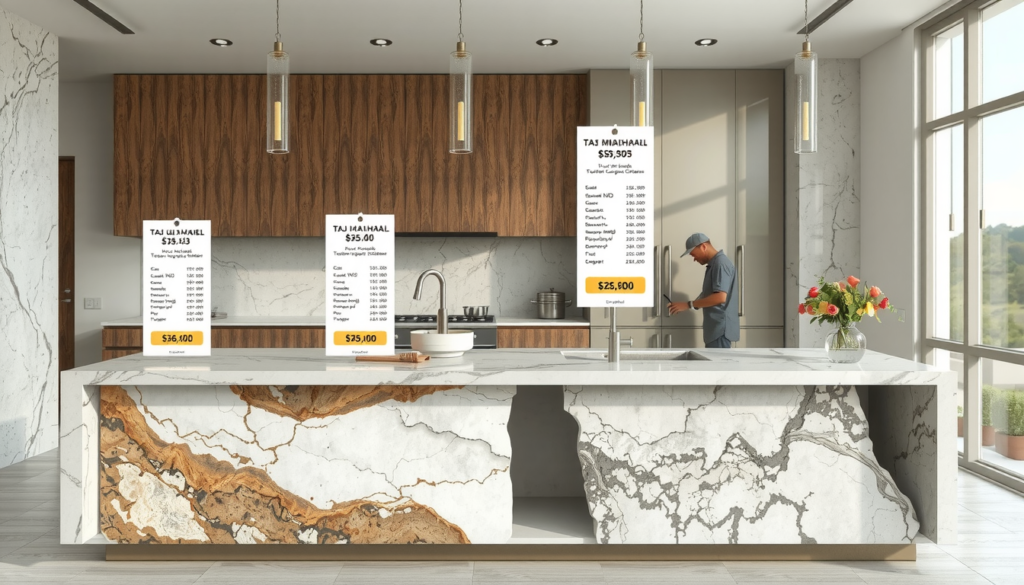
A few key factors push it into the high-end range.
- Rarity and Origin: Most Taj Mahal quartzite comes from Brazil, and supply is relatively limited, which keeps demand — and pricing — high.
- Durability & Hardness: Quartzite is one of the hardest naturally occurring stones. Its hardness, in turn, contributes to its extraordinary durability. However, it also creates difficulties while cutting and finishing. It requires specialized tools and experienced fabricators, which adds to the overall cost.
- Aesthetic Demand: Taj Mahal quartzite has a soft, marble-like look. On the contrary, it does not have the scratching and staining problems which are associated with marble. This is exactly why it’s become one of the most in-demand options.
Balancing the Budget: Smart Cabinet Choices
So, how do you fit a luxury countertop into a real-world budget? One common approach is to balance the budget by adjusting what you spend on cabinetry. Cabinets are usually the second-biggest expense in a kitchen remodel. So this is where a lot of people adjust to make room for a higher-end countertop.
The Cabinet Spectrum
There is a wide range of budget vs luxury kitchen cabinets. Understanding your options is the first step.
- Stock Cabinets: These are the most budget-friendly options. They are pre-made in standard sizes. They’re available for quick delivery. The main drawbacks are limited styles and colors. They also use lower-quality materials.
- Semi-Custom Cabinets: This is where most homeowners tend to land. They start with a stock cabinet framework. But they offer more options for door styles, finishes, and sizes. They offer better quality and more design flexibility than stock.
- Custom Cabinets: These are built to your exact specifications. The value of custom kitchen cabinets lies in their perfect fit. They also offer unique design and superior craftsmanship. It’s also where costs can climb quickly.
Cost-Saving Kitchen Cabinet Ideas
Here are some ideas for kitchen cabinet savings that will make space for your Taj Mahal countertops.
Designers often use a “high-low” approach here. The idea is simple: spend on what stands out, and be more practical elsewhere. A Taj Mahal quartzite kitchen is a perfect example of applying this method.
- Mix and Match: Choose higher-end semi-custom or custom cabinets for your kitchen island. This is often the room’s focal point. After that, you can use more inexpensive, high-quality stock or RTA (Ready-to-Assemble) cabinets on the perimeter walls.
- Consider RTA Cabinets: The quality of RTA cabinets has greatly improved in the last few years. Some RTA options now look surprisingly close to semi-custom — at a fraction of the price. They also require a contractor or you to assemble them on-site.
- Reface, Don’t Replace: Your present cabinet boxes might be in good shape. You may love your kitchen layout. If that’s the case, refacing is a good way to save a huge amount of money. This is done by replacing the doors and drawer fronts. A new veneer is also applied to the boxes.
Use Open Shelving: Swap some upper cabinets for trendy open shelving. This decreases the cabinet costs. It offers a view of the open space and gives a modern touch.
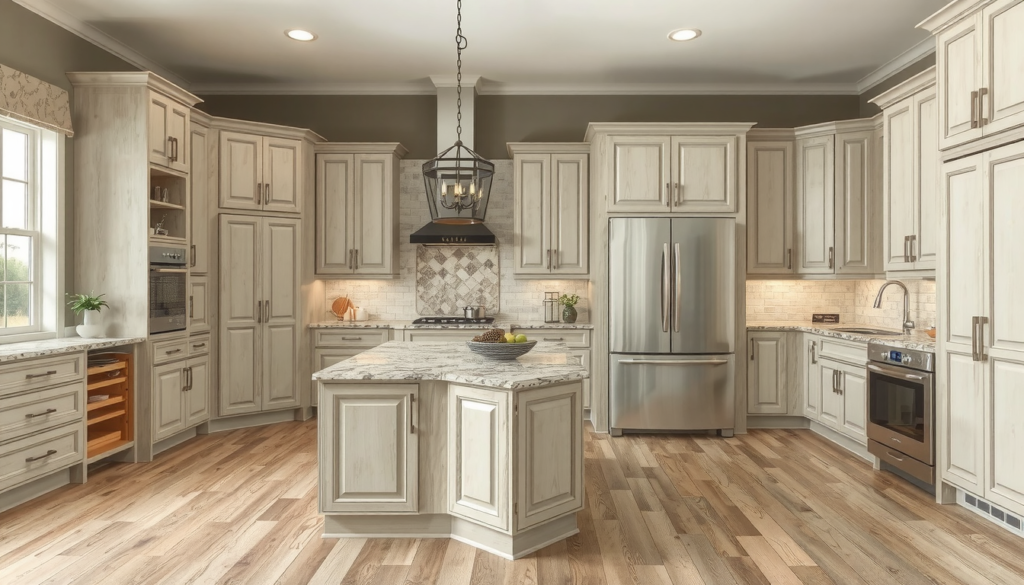
Many homeowners consider engineered quartz as an alternative. It is important to understand the quartzite countertops vs quartz cost and their performance differences.
Quartzite is a natural stone formed under heat and pressure. It is quarried from the earth in large slabs. Engineered quartz, on the other hand, is manufactured using crushed quartz and resins. It’s typically made from about 90% crushed quartz mixed with resins and pigments.
This table compares Taj Mahal quartzite to a popular quartz look-alike.
Feature | Taj Mahal Quartzite | Engineered Quartz (e.g., Cambria Montaaj) |
Cost (Installed) | $135 – $250+ / sq. ft. | $90 – $130 / sq. ft. |
Appearance | Unique, natural veining. Each slab is one-of-a-kind. | Consistent, uniform pattern. |
Durability | Extremely hard, scratch-resistant. | Very durable, non-porous. |
Maintenance | Requires periodic sealing to prevent stains. | Non-porous, no sealing required. |
Heat Resistance | Excellent. | Good, but can be damaged by extreme heat. |
Many consider the rare, natural appearance of quartzite enough to compensate for a higher price and more extra work for caring for it. It is often called the only natural stone that looks like marble but wears like iron.
Is the Splurge Worth It?
At this price point, it’s only natural to ask whether it’s actually worth it. If you look at it from a cost vs. value perspective, there are strong arguments for choosing Taj Mahal.
The Unbeatable Durability
Taj Mahal quartzite is much harder than granite. It is very durable against scratch and heat. Different from marble, it will never be etched or stained with common acids in the kitchen. Such substances are lemon juice or vinegar. Sealed properly, this is the case. Therefore, for years, your counter will remain in great shape.
Resale Value Booster
A high-end kitchen can make a noticeable difference when it comes to resale appeal. The quality and luxurious feel of Taj Mahal quartzite countertops in the kitchen are a message to the buyers. Consequently, the home becomes more attractive and its market value increases.
The “Wow” Effect
As a natural stone, every slab of Taj Mahal is unique. The barely visible color and vein differences in each slab are like a natural work of art. Artificial substances can recreate such a view but cannot have the same depth and character.
That natural variation — subtle as it is — is a big part of the appeal.
Frequently Asked Questions (FAQ)
1. What is the main reason Taj Mahal quartzite is so expensive?
The price mainly comes down to three things: limited supply, difficult fabrication, and strong demand for its marble-like look.
2. Can I find a cheaper alternative that looks like Taj Mahal quartzite?
Yes, several engineered quartz brands offer “Taj Mahal” look-alikes. For example, LX Hausys’ Taj Duna. They provide a similar creamy, veined look at a lower price point and have zero maintenance (no sealing). However, they lack the unique, natural depth and translucence that real quartzite has.
3. How can I save money on kitchen cabinets without sacrificing quality?
A common approach is to mix and match. Use semi-custom cabinets that are more expensive and high-end for a feature island. Choose high-quality stock or RTA (Ready-to-Assemble) cabinets for the perimeter. Refacing or professionally painting existing cabinets is also a good budget-friendly option if the layout is good for you.
4. Is quartzite better than quartz for a busy kitchen?
Both are top-notch choices. Quartzite is the one that has more scratch and heat-resistant features so in terms of hardness, it does have an edge. On the contrary, quartz is non-porous and does not require sealing which makes it easier to live with day to day. The “better” choice depends on your tolerance for maintenance. Sealing is a must for quartzite. It also depends on how much heat resistance you actually need. Direct hot pans are a no-no for quartz.
5. Does pairing affordable cabinets with expensive countertops look bad?
Not at all — as long as it’s done thoughtfully. This “high-low” design approach is a secret of professional designers. The main thing is to make sure the “low” (affordable) element is still high-quality. Modern RTA and stock cabinets can be great-looking. The eye-catching Taj Mahal countertop is the unmistakable star of the show, and it adds to the kitchen’s entire picture.