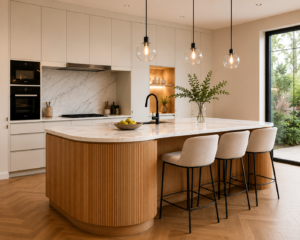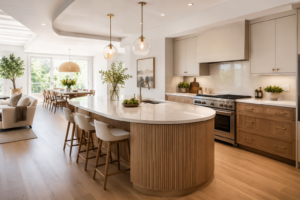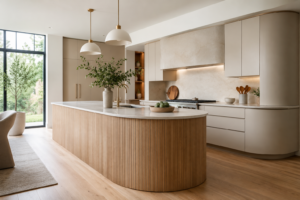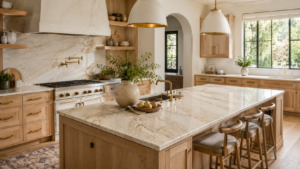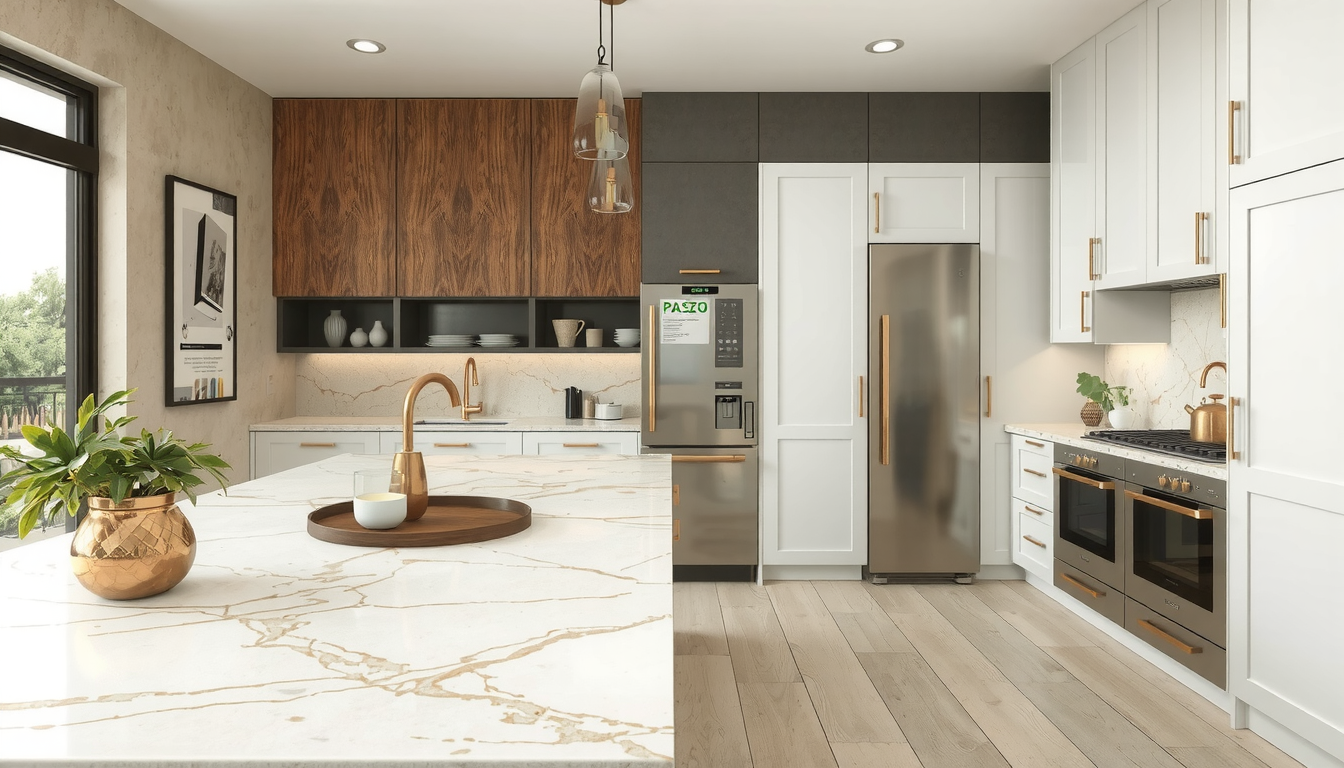
Taj Mahal quartzite has become a popular choice for kitchens that aim for a warm, understated luxury. Its soft tones and subtle veining create a calm backdrop without overpowering the space. Once the countertop is selected, cabinet choices play a major role in shaping the final look. This guide walks through the material itself first, then moves into cabinet color pairings and practical design considerations for a Taj Mahal quartzite kitchen.
Key Takeaways
- Taj Mahal quartzite is a natural stone with a warm white base and soft gold or gray veining. It offers a marble-like appearance with greater durability.
- It works well in kitchens because it resists scratches better than marble and is less prone to etching. Maintenance is relatively simple.
- A few of the popular cabinet colors are classic whites, warm greiges, earthy greens, and bold deep blues or blacks.
- Materials like solid wood, MDF, and plywood vary in their properties. They are different in looks, strength, and prices.
- Trivets should always be used for hot pans. Spills should be cleaned immediately with soap and water. Thus, the countertops will remain looking new for a long time.
What is Taj Mahal Quartzite?
When planning a kitchen, understanding the material matters. Taj Mahal quartzite is a natural metamorphic stone, not an engineered surface like quartz. It forms when sandstone is subjected to intense heat and pressure, creating a dense and durable surface. This transformation results in a dense and highly durable stone.
It is the characteristic look of Taj Mahal quartzite that makes it a true unique choice. Generally, the background is a warm white or creamy beige or light taupe. On this soft canvas of color, you will find light floating waves of veining. They come in colors like gold, caramel, taupe, and light grey. The minimalism that the veins present is what gives it the chic look of marble. However, it is much more durable.
To better understand its unique qualities, here are its key properties:
- Composition: Primarily it is made of quartz. Quartz is the second hardest mineral in nature.
- Hardness: It has around 7 Mohs hardness level. This gives it a higher anti-scratch resistance than granite.
- Porosity: It has very little porosity. Therefore, it does not absorb liquids that easily. Nonetheless, the Natural Stone Institute advises that you should seal all natural stone to avoid the risk of staining.
- Appearance: It adds the feel of luxury and softness that marble has to avoid the worries of etching or scratching.
Why Is It Ideal for a Kitchen Countertop?
The characteristics of Taj Mahal quartzite are also the reasons that make it the best countertop material for busy kitchens. It becomes a favorite among homeowners due to its beautiful presentation and functional performance because this will assure them peace of mind for many good years.
One of its main advantages is durability. Kitchen countertops see constant use—knives, heavy cookware, and food prep—and Taj Mahal quartzite generally handles that wear well. Its hardness helps it resist scratches and chips better than marble. It is also less prone to etching from acidic foods such as lemon juice or vinegar. Acidic food spills can cause surfaces to dull over time, which is called etching. For instance, lemon juice or vinegar.
The fact that it is so strong is the reason it has the next advantage: low maintenance. Marble typically requires more careful maintenance and specialized cleaners. On the other hand, a quaint quartzite kitchen does not need special care. A one-off sealing after it is correctly installed is all that is required, and it only needs re-sealing now and again. For everyday cleaning, simply wiping down with mild soap and water is more than enough.
Its warm, neutral palette helps the design stay relevant over time and works well with both traditional and modern kitchens. The color palette, which is warm and neutral, can be combined with a lot of design styles. It is flexible from the traditional form to the modern variant. This makes Taj Mahal quartzite a practical long-term choice for kitchen countertops.
Feature | Taj Mahal Quartzite | Marble | Granite |
Durability | Excellent (Resists scratches & etching) | Fair (Prone to scratching & etching) | Very Good (Resists scratches) |
Maintenance | Low (Requires periodic sealing) | High (Requires frequent sealing, careful use) | Low (Requires periodic sealing) |
Aesthetic | Soft, elegant, warm veining | Classic, dramatic, cool veining | Speckled or patterned, wide variety |
Popular Cabinet Color Pairings
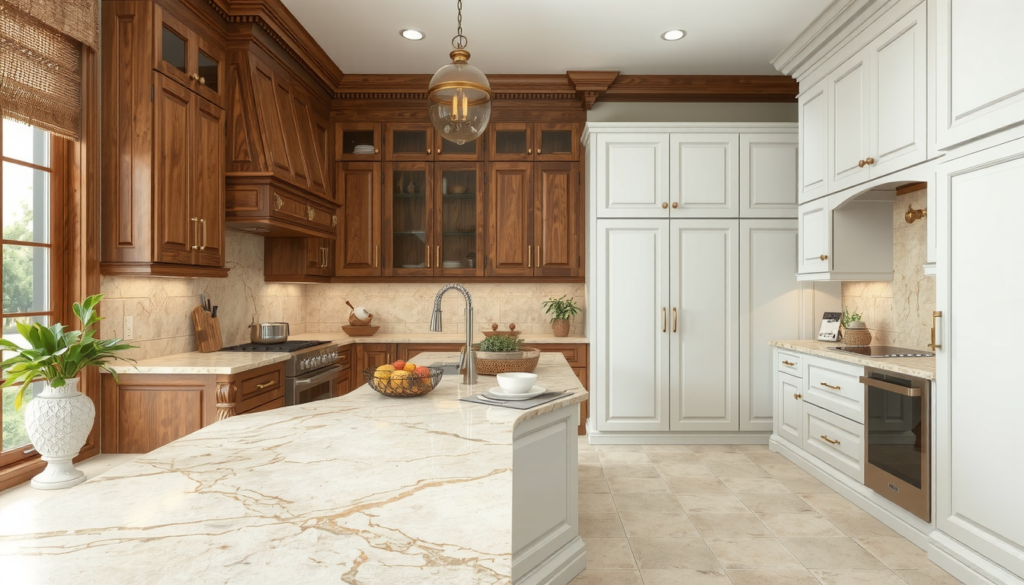
Choosing cabinet colors is an important step when designing a Taj Mahal quartzite kitchen. The stone’s neutrality gives it a lot of style choices. Here are the most popular pairs we recommend on our client list. Viewing the taj mahal quartzite kitchen pictures will help you picture these beautiful combinations.
Classic White & Off-White Cabinets
This is one of the most timeless combinations. The combination of Taj Mahal and white or off-white cabinets brings together a bright, airy and spotless environment. Light cabinets allow the warm veining in the quartzite to stand out without competing for attention. This brings a hint of warmth to the space. This look is perfect for classic, transitional, and modern farmhouse kitchens. With this look, the whole room gets the impression of being bigger and more open.
Warm Greige & Taupe Cabinets
For a refined and cohesive appearance, the best option is to choose a cabinet color that comes directly from the stone’s veining. Warm gray, greige (a mixture of gray and beige), or taupe cabinets create a high-end, cohesive atmosphere. This creates a cohesive, understated look that feels balanced and relaxed. It wraps the room in a soothing, unified color. This approach creates a cohesive look that feels intentionally designed.
Earthy Green & Sage Cabinets
One major trend for 2026 is adding natural tones to the interior. Soft green or sage cabinets pair naturally with the stone’s warm tones and highlight its organic character. The green tones prominently exhibit the organic, earthy essence of a natural stone. The combination gives off a feeling of calm, grounding, and being one with nature. It’s an appropriate choice for modern and traditional styles alike.
Deep Blue & Black Cabinets
If you are looking to get some drama and a dose of luxury and to consider that dark cabinet will the way to go. Deep navy blue or even black cabinets are going to make a rather bold statement. The dark color shade will serve as a striking contrast, which lets the light cream Taj Mahal countertops shine in the spotlight. This contrast works especially well in modern or transitional kitchens. This makes the atmosphere dark and sophisticated.
Modern Kitchen Case Studies
Theory does help. But to truly ignite your inspiration, you have to see these pairing concepts implemented in real homes. Below are two case studies from our portfolio, explaining how these combinations are brought to life.
Case Study 1: The Light & Airy Transitional Kitchen
A family came to us looking for a bright, timeless kitchen. They wanted to have a bright, timeless kitchen that would be the heart of their home. In addition, it needed to feel open, welcoming, and something that would bear the daily pressure of living with young kids.
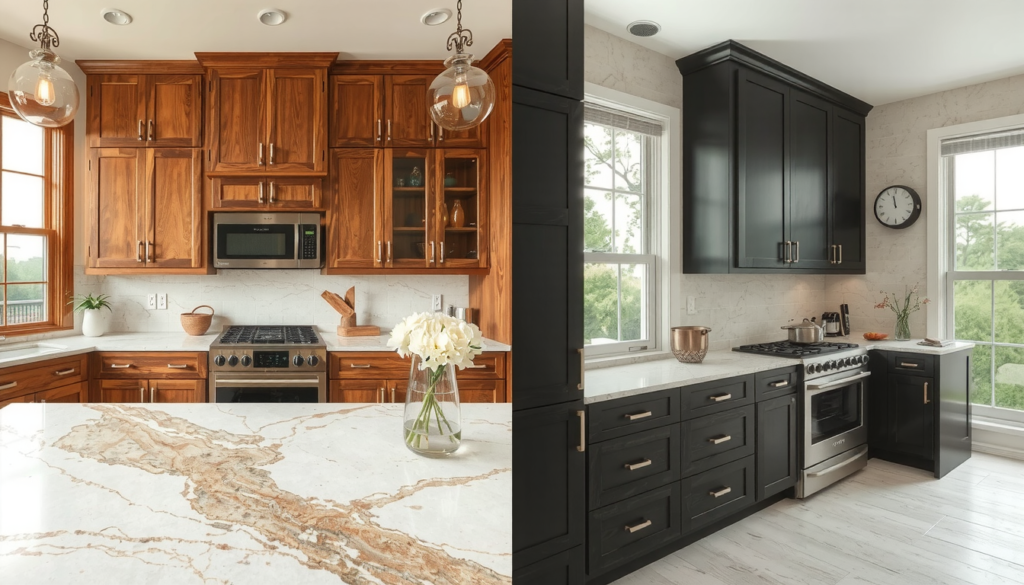
We paired Taj Mahal quartzite countertops with off-white shaker cabinets to keep the space light and classic. The soft white paint brightened the room instantly. We complemented the look with brushed brass cabinet pulls and knobs. The brass accentuated the flecks of gold in the countertop and added warmth also. For the backsplash, we chose a simple, handmade-look ceramic tile in an off-white shade that matched the cabinet.
The end result was a room with perfect kitchens with taj mahal quartzite, that is beautiful to look at as well as being very practical. It is a perfect combination of classical design and fresh modernity. Hence, the family will enjoy this space for many years.
Case Study 2: The Moody & Sophisticated Entertainer’s Space
Our next clients were a couple who loved hosting dinner parties and were seeking a kitchen design that is stunning and eye-popping enough for their guests and would also be a stylish background for social gatherings.
We chose a high-contrast palette to create visual impact. The light, creamy Taj Mahal countertops were teamed up with the flat-panel, modern navy blue cabinets set in a bold, deep shade. To assuage the space in its feel of coldness, we introduced natural wood elements. We floated walnut finish shelving to exhibit glassware and decor, thus, achieving a more organic balance to the blue cabinets’ cooler tones.
This is one of our best projects with taj mahal kitchens, as it feels decadent and atmospheric while also warm and inviting. It is a classic example of the versatility that this exceptional stone has.
Recommended Cabinet Materials to Pair with Taj Mahal Quartzite
Beyond color, cabinet material affects durability, cost, and overall appearance. The material is responsible for the price, strength, and final look of your kitchen. The most used ones are…
- Solid Wood (e.g., Maple, Oak):
- Pros: This choice is timeless, is strong, and has great longevity. It is available in a stained version with visible grains or a painted one in any desired color. This is a high value for holding its classic design and being sought after.
- Cons: It can be the highest price point option. Changes in humidity could cause wood to expand and shrink, posing a concern in some climates.
- MDF (Medium-Density Fiberboard):
- Pros: MDF is an engineered product made of wood fibers compressed into sheets. MDF usually holds its shape better than solid wood so it doesn’t warp over time. The surface is perfectly smooth and that’s why a flawless painted finish is possible. It is also more affordable than solid wood.
- Cons: MDF cannot be stained to look like wood. When the veneer is coated with paint, it can be heavy which makes it prone to damage if the paint is chipped.
- Plywood:
- Pros: Plywood is produced from thin layers of wood veneer bonded together with adhesive, making it highly durable. It resists water better than MDF and is also good for securing screws and other hardware.
- Cons: It is often more expensive than MDF. Plywood edges require some kind of finishing, like veneer or banding, to look clean.
For more information, check out [This Old House’s in-depth guide about kitchen cabinets](https://www.thisoldhouse.com/kitchens/21015243/all-about-kitchen- cabinets).
Frequently Asked Questions
Here are answers to some common questions we receive about designing a taj mahal quartzite kitchen.
How much does Taj Mahal quartzite cost?
The cost of the Taj Mahal quartzite rocks can be highly different between $90 to $200 for a square foot. The prices will depend on the quality of the slab that you buy and the thickness of material. Your site location and the fabricator you choose also play a role. Be sure to check with several vendors.
Is Taj Mahal quartzite hard to maintain?
No. Taj Mahal quartzite is generally considered low maintenance. It is the installer’s responsibility to seal it properly then it should be resealed every one or two years depending on the use. For daily cleaning, you need just a soft cloth with mild soap and water. Also, you should avoid using any harsh or abrasive chemical cleaners.
What backsplash goes well with Taj Mahal quartzite?
There are several backsplash options that pair well with Taj Mahal quartzite. One of the cleanest and best-looking finishes is with classic subway tiles matching the countertop’s background. If you’re wanting a seamless, high-end look, you can use Taj Mahal slabs as a backsplash running up the wall. Neutral tone tiles that are textured like zellige are also great in adding interest and depth to the design.
Can you put hot pans on Taj Mahal quartzite?
It’s best not to place hot pans directly on the surface. Although quartzite is extremely heat resistant, significant and abrupt temperature changes can cause some problems – thermal shock. This can lead to cracking or discoloration. It is wise to use trivets or hot pads for the protection of your investment.
How can you tell if it’s real Taj Mahal quartzite?
One reliable way is the glass test. The quartzite will scratch a piece of glass but the marble will not do that. The marble, which is often misidentified as quartzite, is also not resistant to acid. If you put some lemon juice on it, it would damage it. However, real quartzite will not be damaged by eating lemon juice. The safest way to be sure is to purchase from a reputable stone dealer.