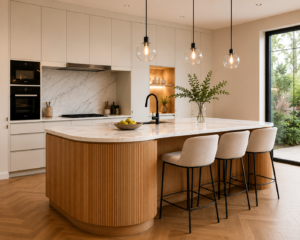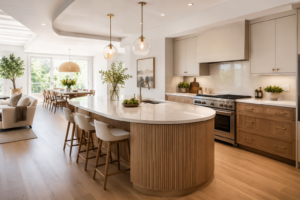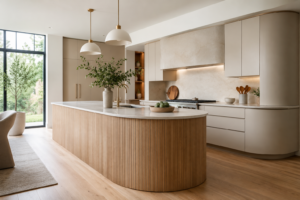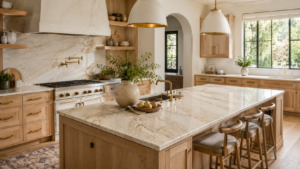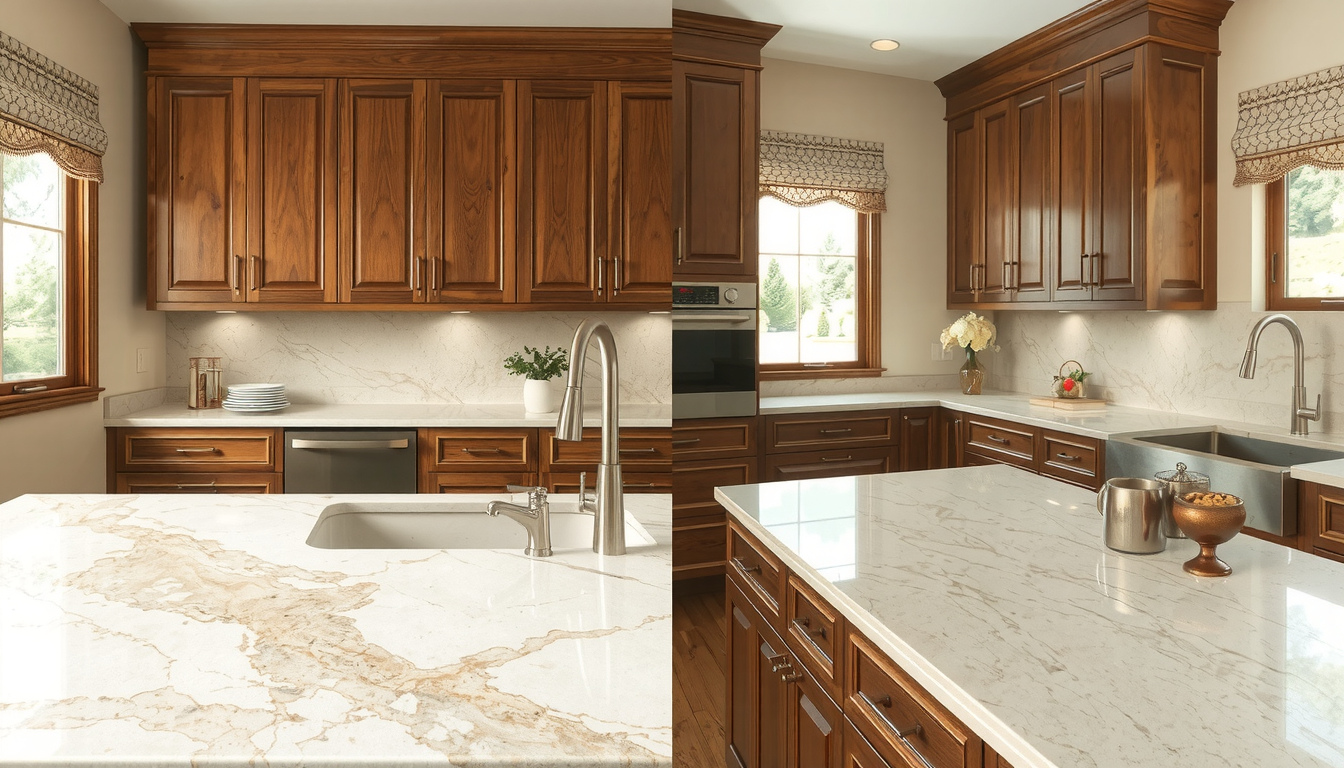
Choosing a countertop usually ends up shaping the whole feel of the kitchen. And if you’ve narrowed it down to Taj Mahal quartzite, you’re already looking at one of the most popular natural stones in current kitchen design.
The real decision now is the finish: honed or polished.
The finish affects the entire feel of the kitchen — especially once cabinet color, lighting, and hardware start coming together. A honed surface usually feels softer and quieter, while a polished finish tends to make the space look brighter and more refined.
Some pairings feel softer and more relaxed, while others make the kitchen look brighter and more polished. A lot depends on how the countertop finish interacts with the cabinets, lighting, and overall kitchen style.
Key Takeaways
- Honed Taj Mahal works especially well in kitchens that lean modern, organic, or slightly minimalist. It’s commonly paired with white oak, walnut, or matte-painted cabinetry.
- Polished Finish for a Classic Look: Polished Taj Mahal quartzite has high shine and reflects light. This finish is the best alternative for classic, traditional, or glamorous kitchen designs. It contrasts wonderfully with satin or semi-gloss cabinetry.
- Care is Different, Not Harder: A honed finish is smudge-proof but needs to seal properly to prevent stains. Polished quartzite handles stains well, but fingerprints and water spots show up faster. It requires wiping down frequently.
- Cabinet Pairing is Key: The kitchen usually feels more cohesive when the cabinet finish and countertop finish share a similar visual softness or reflectiveness. A matte top with matte cabinets gives a smooth, textured look. A glossy top with glossy cabinets gives a bright, formal feel.
- Always Get Samples: Large samples almost always make the decision easier, especially once you see them under your own kitchen lighting. Place them next to your cabinet doors and look at them under your kitchen lighting throughout the day.
Why the Finish Changes the Entire Kitchen
Most homeowners choosing Taj Mahal quartzite end up debating the same thing: honed or polished. It’s a common decision for homeowners planning a kitchen remodel. And the difference goes beyond surface shine. The finish changes how the entire kitchen feels visually.
A honed finish has a softer, matte appearance, while polished quartzite reflects much more light and feels visually sharper.
Most homeowners end up deciding based on three things: the style of the kitchen (modern vs classic), the finish of the cabinet, and your lifestyle. Once you see how the finishes behave in real kitchens, the choice usually becomes much easier.
Meeting with the Star of the Show: Taj Mahal Quartzite Stone
Before we dive into the comparison of the two finishes, let’s get to know the stone we are working on. Taj Mahal quartzite stands out because it has the soft warmth of marble without being nearly as delicate. Do not confuse it with engineered quartz.
Like other quartzites, Taj Mahal forms under intense heat and pressure, which is what gives the stone its durability.
What draws most people to it is the color variation. Taj Mahal Quartzite has a soft white background and subtle gold veins. The overall tone usually feels warmer and softer than a bright white marble. The veining can also contain shades of grey and tan. That variation gives the stone a more relaxed, natural look instead of a sharp, high-contrast pattern.
One reason Taj Mahal remains so popular is that it gives you the softness of marble without the same level of maintenance anxiety. Unlike marble, Taj Mahal quartzite is far less sensitive to scratches and acidic spills. That balance is one reason it works so well in busy kitchens.
Honed vs. Polished: A Face-to-Face Comparison
The finish you choose for your Taj Mahal quartzite will drastically affect its look and functionality. Let’s discuss the two most sought-after options: either honed or polished quartzite countertops.
Why Honed Taj Mahal Feels Softer in a Kitchen
A honed finish keeps the surface smooth but removes the reflective shine. Instead of reflecting light, the surface diffuses it. Its texture is soft and smooth.
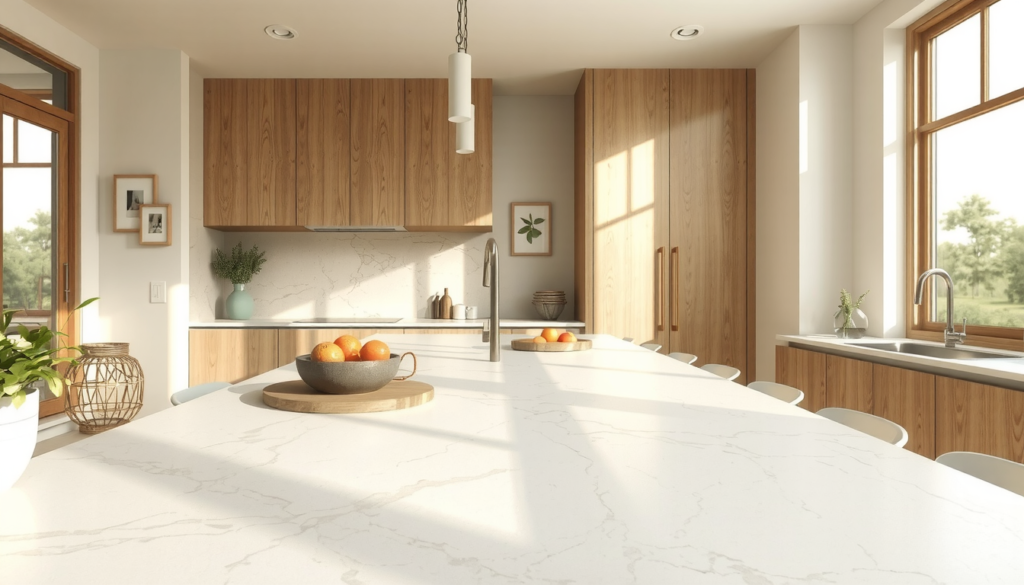
In a honed finish, the stone usually feels softer overall, with veining that looks more muted and less contrast-heavy. That quieter look works especially well in organic modern kitchens, Scandinavian-inspired spaces, and newer minimalist designs.
In kitchens with a lot of natural light, honed quartzite usually feels calmer because the surface diffuses glare instead of reflecting it. That softer finish tends to work especially well in kitchens designed to feel calm and understated.
Where Polished Taj Mahal Works Best
Polished quartzite is still the more traditional choice, especially in higher-end kitchens. The surface is ground and polished until it achieves a high degree of gloss. The reflective surface makes the stone feel brighter and more dramatic, especially under pendant or under-cabinet lighting.
Polishing also brings out more contrast in the veining, making the movement in the stone appear more dramatic. In smaller kitchens, the reflective surface can even make the room feel a bit more open. It also gives the kitchen a cleaner, more formal look. That’s why the polished Taj Mahal still works well in both classic and contemporary spaces.
Here’s a quick side-by-side comparison.
Quick Comparison Table
Feature | Honed Taj Mahal Quartzite | Polished Taj Mahal Quartzite |
Look & Feel | Matte, soft, velvety | Glossy, smooth, reflective |
Light Reflection | Low (absorbs light) | High (reflects light) |
Vein Appearance | Softer, more blended | Crisp, defined, dramatic |
Design Vibe | Modern, organic, casual, warm | Classic, luxurious, formal, bright |
Hides Fingerprints | Excellent | Poor (shows smudges easily) |
Stain Resistance | Good (but requires consistent sealing) | Excellent (less porous surface) |
The Art of Pairing: Matching to Kitchen Cabinets
This is usually the point where the kitchen either starts feeling cohesive — or slightly mismatched. Let’s explore cabinet finish matching countertops for both honed and polished stone.
Designing with Honed Quartzite: A Modern Kitchen
Honed Taj Mahal usually works best in kitchens that lean softer and more natural overall. With honed quartzite, the texture usually matters more than shine.
The most suitable cabinet finishes that go with honed Taj Mahal quartzite are matte, low-sheen, and natural wood. For the color choice, consider the warm white tones like Benjamin Moore Swiss Coffee. Soft greige, taupe, and natural woods like white oak or walnut are also great options. Muted colors like sage green or deep navy also pair nicely with the warmer undertones in the stone.
This combination tends to feel calmer and more lived-in than a fully polished kitchen. When honed quartzite is paired with matte cabinetry, the kitchen tends to feel quieter and less visually busy. The space tends to feel softer and more relaxed without losing its polished look. This combination is suitable for Modern Farmhouse, Scandinavian, and Organic Modern kitchen types.
Designing with Polished Quartzite: A Classic Design
If you want to go for a classic and luxurious polished quartzite kitchen design, then the choice of cabinets is just as crucial. The goal is usually to let the countertop become one of the brighter visual elements in the room.
The finest finishes for cabinets are satin, semi-gloss, and even a high-gloss lacquer. Satin and semi-gloss cabinets reflect light in a similar way, which helps the kitchen feel brighter and slightly more open overall. As for colors, you can never be wrong with the classic icy white or rather the striking, high-contrast black. Rich cabinet colors — especially deep green, charcoal, or muted blue — can make polished Taj Mahal feel more dramatic without looking overly formal
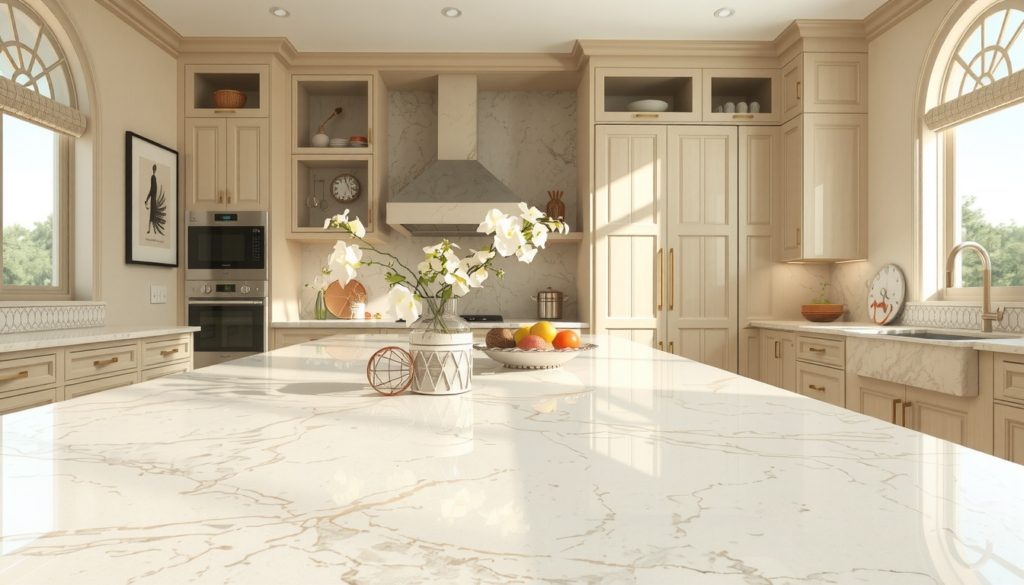
In a kitchen with a polished Taj Mahal, the under-cabinet lighting not only illuminates the workspace but also creates a beautiful atmosphere. At night, the light reflection from the countertop can make the entire kitchen feel brighter without adding more fixtures. This style matches well with Traditional, Classic, Glam, and high-end Contemporary kitchens.
Quick Guide: Modern vs. Classic Kitchen Cabinets
Find below a quick guide for pairing modern kitchen cabinets with the classic ones.
- If you want the kitchen to feel softer, quieter, and more contemporary, honed Taj Mahal usually works better.
- If you prefer a brighter and slightly more formal look, polished tends to make more sense.
The Practical Side: Daily Life and Strength
Aside from design, a countertop should be a part of the furniture that fits your personality. Here’s how the two finishes compare in everyday use.
The Need for Sealing
The honing process is when the surface of the stone is ground. This process opens up the natural pores of the stone a little bit. Because the surface is slightly more open, honed quartzite can absorb liquids faster if the sealant wears down. It needs to be sealed during the installation and it is also possible to require re-sealing every year or so.
In contrast, polished quartzite has a less porous surface. The polishing process closes those pores. This gives it better stain resistance from the start. Sealing still matters with polished quartzite too — just usually less often. Maintenance is usually where homeowners start leaning one way or the other.
Daily Life: Spills and Smudges
This is one area where honed surfaces are easier to live with day to day. It is great at hiding crumbs, dust, and the occasional smudge. You will not be constantly wiping it down. If the sealant is weak, oil spots may appear on it. These can usually be successfully removed with a specific stone cleaner known as a poultice.
Polished quartzite is almost the opposite. It displays every single fingerprint, water drop, and stain very prominently. To attain the look of cleanliness, it has to be wiped more often. The positive side is that the liquid spills are easily wiped off without soaking into the surface.
How the Finishes Handle Wear Over Time
Quartzite is an excellent choice as it is a natural stone. With its Mohs hardness rating of about 7, this stone is considered to be tough (diamond has a rating of 10). Both finishes, whether they are honed or polished, are able to resist knives, pots, and pans scratches effectively.
Even though quartzite is extremely durable, small scratches or dull spots can still happen over time, especially around acidic spills like lemon juice. In fact, such scratches are more hidden with the honed finish. Conversely, on a polished finish, the scratch, or other damages would be much easier to see as they would disrupt the shiny, reflective surface.
FAQ: Your Top Questions Answered
Here are responses to some frequently asked questions regarding the selection of one of the two Taj Mahal quartzite finishes, honed or polished.
Is honed Taj Mahal quartzite harder to maintain than polished?
No, not particularly, but maintaining it requires a different approach. It usually needs a bit more attention when it comes to sealing. Besides, it’s also much more forgiving when it comes to everyday messes such as fingerprints and crumbs. On the other hand, polished surfaces usually need more quick wipe-downs if you want them to look spotless.
Will honed Taj Mahal quartzite stain from wine or oil?
If the sealant is in good condition and is maintained properly, then it will not get stained. However, if the sealant has worn or broken down, liquids can start soaking into the surface. You can check your sealant by dropping a few water droplets on the surface. If the water forms beads, your seal is intact. Otherwise, if it soaks in, you need to reseal.
Does polished quartzite look dated?
Not really. Polished stone has been around for decades, but it doesn’t automatically feel outdated. It does not appear to be old-fashioned; it rather has a “traditional” or “fancy” feel. Most of the look comes down to the cabinet style, hardware, and lighting around it. The kitchen design using polished quartzite can look very sleek and up-to-date in a minimalistic way, such as with flat-panel cabinets and only simple hardware.
What is the best finish for kitchen cabinets to hide dirt?
For cabinets, a satin or low-sheen painted finish offers the best balance. It is stronger and easier to clean than a flat or matte finish. It also doesn’t show fingerprints and small problems as much as a high-gloss finish does. This makes it the best finish for kitchen cabinets in a busy family home.
Are there other finishes for Taj Mahal quartzite?
Yes, a “leathered” or “brushed” finish is another popular option. It has a soft shine similar to honed, but with a more textured, bumpy surface. This finish is amazing at hiding messes and adds a unique feel to your kitchen.
Which One Usually Works Better?
By now, you should have a clear idea of which finish fits your vision. Most people end up choosing based on whether they want the kitchen to feel softer and quieter or brighter and more defined.
- Honed usually feels softer, quieter, and easier to live with visually.
- Polished tends to feel brighter, sharper, and a little more formal.
Before making a final decision, it’s worth seeing larger samples of both finishes in your actual kitchen. Taj Mahal changes quite a bit depending on lighting, cabinet color, and even the time of day.