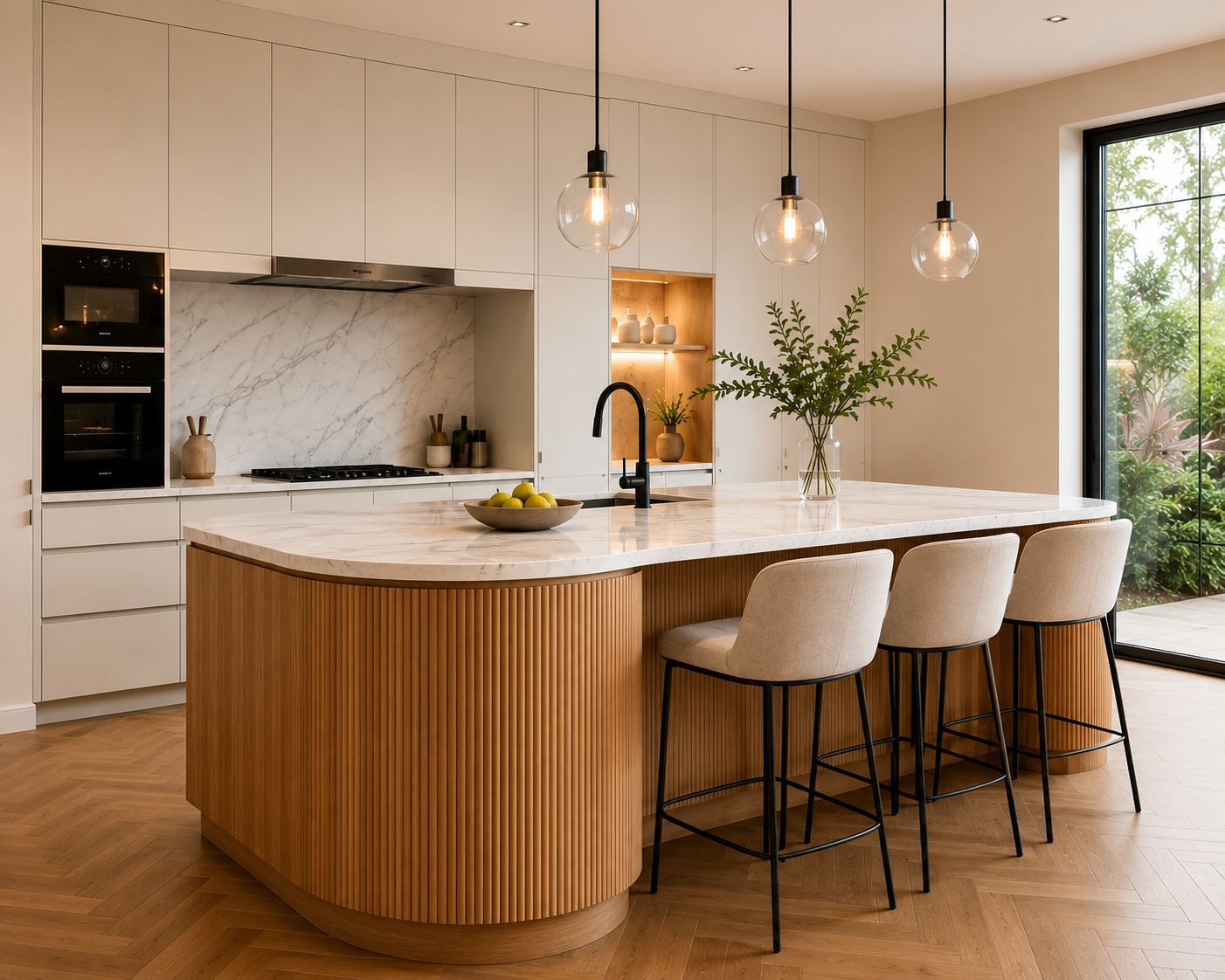
Curved cabinets are often discussed as a design detail first. On site, they usually come up for a simpler reason: an island end feels too sharp, a vanity sits too close to a door, or a long cabinet run looks heavier than expected from the main viewing angle.
Those details may look small on a drawing. After installation, they affect how people move through the room, which corners they pass every day, and which cabinet end catches the eye first.
So the choice between curved and flat cabinets should not start with “which one looks better.” It should start with the layout. Where are the exposed edges? Where do people turn? Which cabinet ends are visible? How much custom fabrication and installation work is the project willing to take on?
Flat cabinets should handle most of the storage. Curved cabinets make more sense when the shape solves a real edge, movement, or visual weight problem.
Quick Answer
For most projects, use flat cabinets for the main runs. They are easier to plan, easier to manufacture, faster to install, and easier to keep under control when the budget is tight.
Use curved cabinets only where the shape does useful work. Good places include island ends, peninsula corners, vanity sides, hallway cabinets, bar units, reception counters, and other exposed edges people see or pass closely.
A simple rule works well: use flat cabinets where storage efficiency matters most. Use curved cabinets where the curve improves movement, softens a hard corner, or makes a visible cabinet block feel less heavy.
Curved Cabinets vs. Flat Cabinets: Quick Comparison
Comparison Point | Curved Cabinets | Flat Cabinets |
Overall Look | Softens exposed ends and makes large cabinet blocks feel less heavy | Keeps the cabinet run clean, straight, and visually quiet |
Best Use | Island ends, peninsula corners, rounded vanities, bar cabinets, reception counters, and feature units | Full kitchen runs, bathrooms, offices, wardrobes, pantry walls, and storage-heavy areas |
Space Flow | Helps tight walkways and turning points feel less harsh | Works best in layouts with enough clearance around corners |
Safety | Reduces hard exposed corners in busy or narrow areas | Sharp corners may need more care near walkways, doors, or family-use areas |
Manufacturing | Requires radius planning, bending, templates, or custom fabrication | Uses standard panel cutting, edge banding, drilling, and assembly |
Installation | Radius, countertop edge, side panels, and toe kick all need to line up | Faster and more familiar for most cabinet installers |
Cost | Usually costs more because the curved section needs extra design, production, and finishing work | Easier to price and usually more cost-efficient across large cabinet runs |
Maintenance | Curved doors, panels, and finishes can be harder to remake or repair | Flat doors, drawer fronts, panels, and edge banding are easier to replace |
Design Role | Best used as a targeted layout or visual solution | Best used as the main cabinet system |
Style and Visual Impact
Flat cabinets usually stay in the background, which is often what a project needs. Their straight lines help kitchens, bathrooms, wardrobes, and storage walls look clean without pulling too much attention.
The finish does most of the visual work. A matte white door feels simple. Wood grain brings in warmth. Painted doors with hardware can lean more classic. Because the cabinet shape stays basic, other elements — countertops, backsplashes, flooring, lighting, and appliances — have more room to stand out.
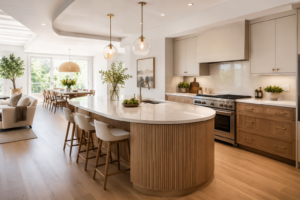
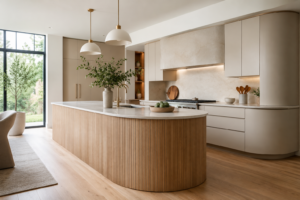
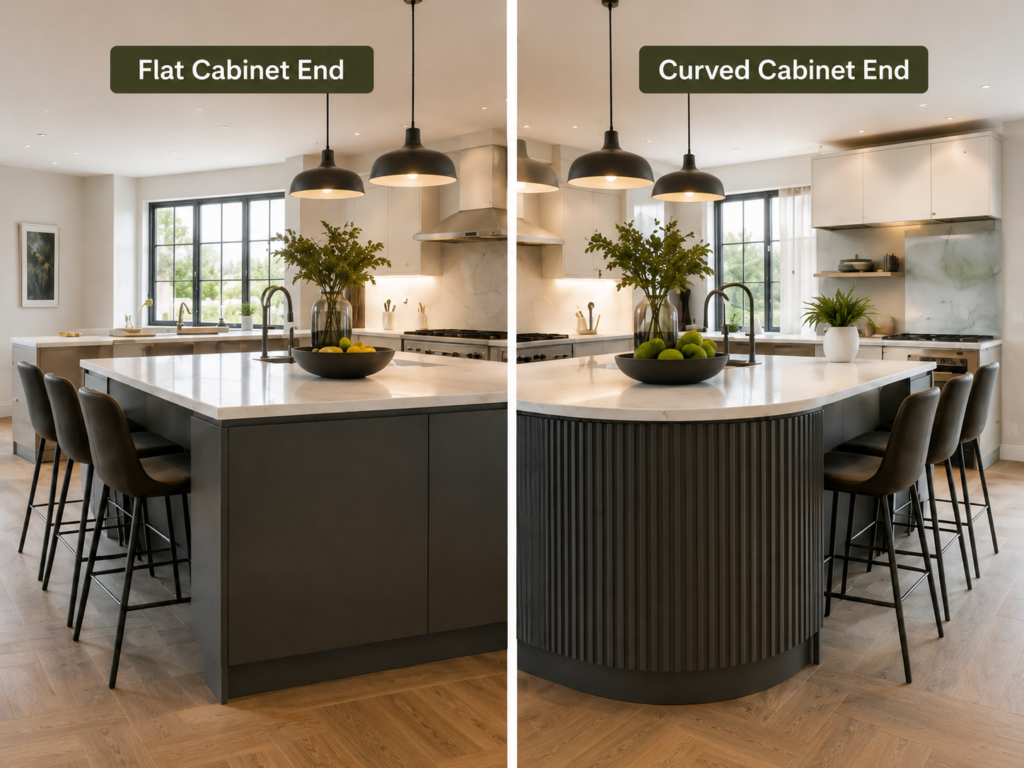
Curved cabinets change the feeling faster. A rounded end or curved front breaks up the hard lines created by walls, tiles, worktops, and appliances. Instead of ending at a sharp corner, the cabinet feels like it turns with the room.
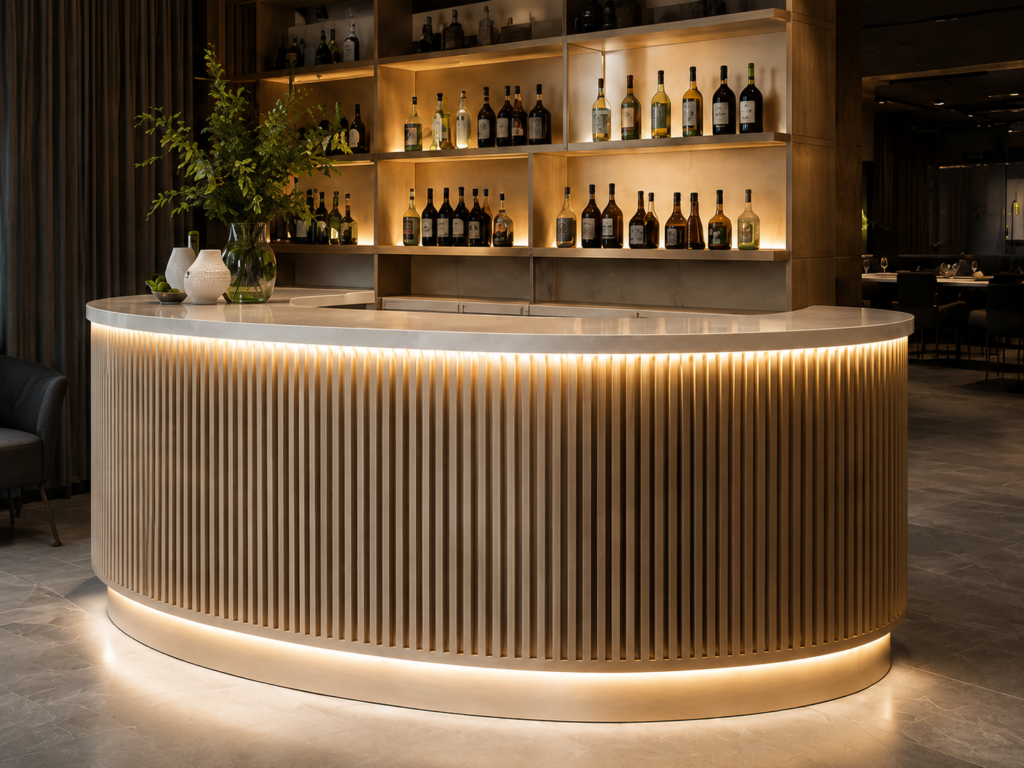
This is most useful on exposed edges. A curved island end can make a large island feel less blocky. A rounded vanity can soften a compact bathroom. A curved bar cabinet or media unit can become a feature without relying on bold colors or heavy decoration.
The key is restraint. One well-placed curve usually looks more intentional than several curved details scattered around the room. Homes & Gardens makes a similar point in its discussion of curved kitchen islands: curves can help soften sharp edges, improve movement, and make tight kitchen areas feel easier to use. That is exactly why curved cabinets work best as targeted details, not as something applied across every cabinet run.
Space Flow and Safety
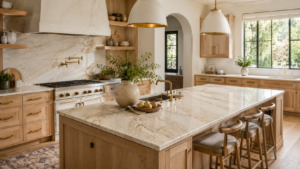
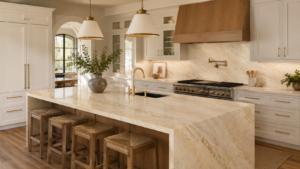
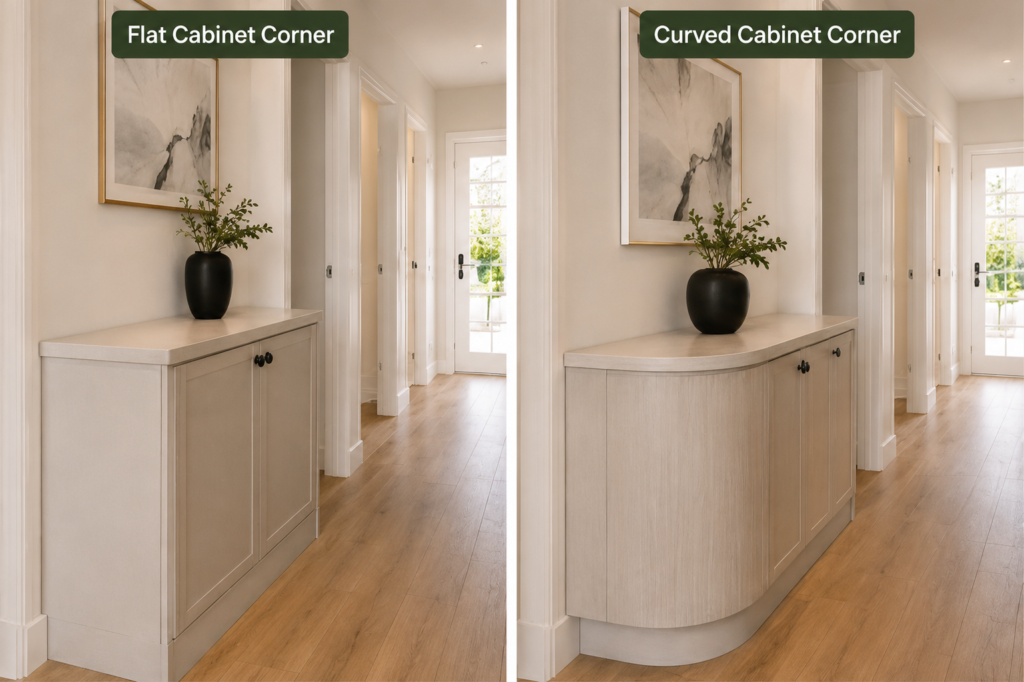
Cabinet corners matter most when people pass close to them. In a wide kitchen or along a straight storage wall, a flat cabinet end is usually fine. There is enough clearance, so the corner does not affect daily movement.
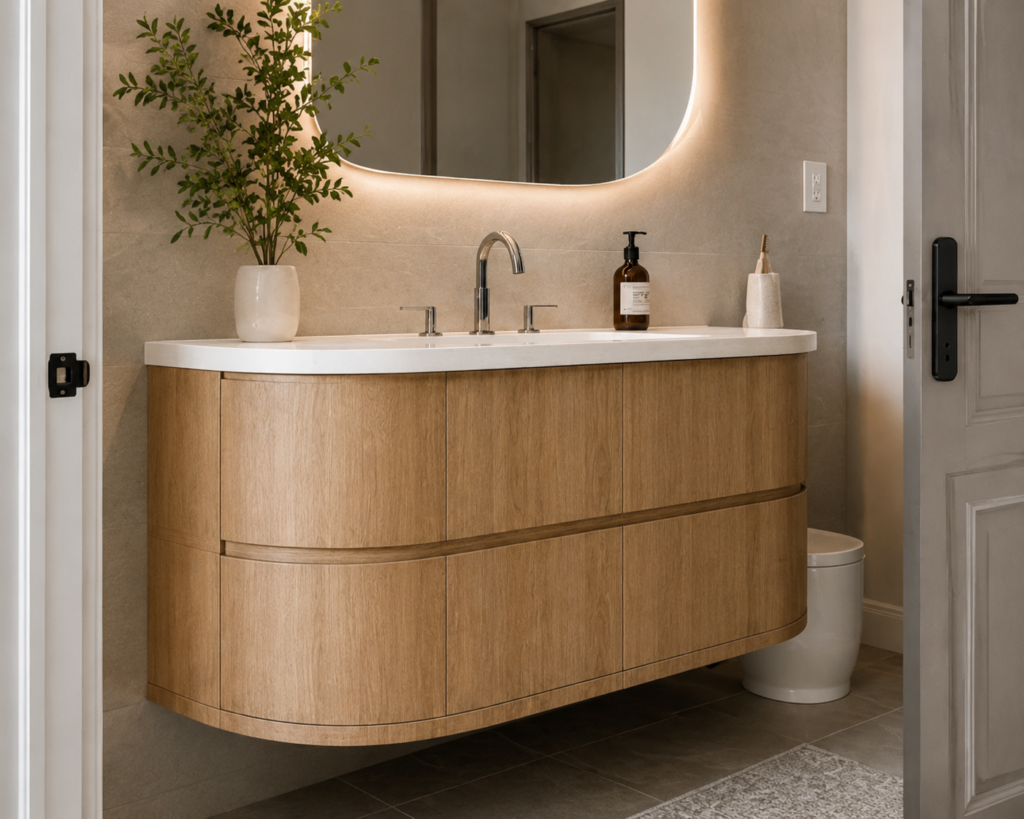
The problem shows up in tighter spots: the end of an island, the side of a vanity, a hallway cabinet, or a peninsula that pushes into a walkway. These are the areas where people turn, carry plates or laundry baskets, open drawers, or walk past the same cabinet edge several times a day. A sharp corner can make the space feel tighter than the floor plan suggests.
A curved end softens that contact point. It will not rescue a bad layout, but in a narrow aisle, it can make the turn feel less harsh. This is especially useful in homes with children, older family members, or anyone who needs a bit more clearance around cabinet edges.
Construction and Installation
Flat cabinets are easier to build because most parts repeat.
Panels can be cut, edged, drilled, and assembled in standard ways. For a factory or workshop, that means fewer special steps. For installers, it means the cabinets are easier to line up with walls, floors, appliances, and countertops.
This matters on renovation schedules. If a door front gets scratched or a drawer panel needs to be remade later, the replacement is usually straightforward. The whole cabinet system does not depend on one exact radius or a one-off template.
A curved section needs to be confirmed much earlier. Once production starts, installers cannot simply “make it work” on site.
The curve has to match the countertop, side panels, shelves, toe kick, and the flat cabinets next to it. A small measuring error that might disappear on a straight cabinet can become obvious once the cabinet line starts to bend.
Curved cabinet parts can be made in different ways, including kerf bending, laminated layers over a form, or steam bending for certain solid woods. For most clients, the method matters less than the finished result: the curve needs to stay smooth, the finish needs to follow it cleanly, and the cabinet still has to look right after installation.
Finishing is where weak curved work shows quickly. Veneer, laminate, paint, or lacquer has to wrap the curve without ripples, rough edges, or uneven gaps. A well-made curved cabinet looks planned. A poorly planned one can make the whole cabinet run feel slightly wrong, even if the straight sections are fine.
A curved cabinet is custom work. Treating it like a small decorative upgrade is where many projects get into trouble.
Cost and Budget Planning
Flat cabinets are usually easier to budget because most of the work is predictable. A long kitchen wall with flat base cabinets and wall cabinets can be measured, priced, produced, and installed with fewer special steps. The sizes repeat, the panels are easier to cut, and installers generally know what they are dealing with on site.
The final cost still depends on the cabinet grade and finish. Laminate, lacquer, and wood veneer will not sit in the same price range. Stock, semi-custom, and fully custom cabinets also vary a lot. But in most cases, the flat shape itself does not create much extra cost.
Curved cabinets can change the budget faster. As a rough guide, a curved detail may add around 20% to 50% or more to that section of the cabinetry, especially if the design includes curved doors, curved drawer fronts, special finishes, or a countertop edge that has to follow the same radius.
A small rounded side panel at the end of an island may be manageable. A full curved unit with custom doors, a shaped countertop, and a high-gloss lacquer finish is a different conversation. At that point, the cost is not just for “one curved corner.” It includes extra design time, production work, finishing control, and more careful installation.
This is why curves should be placed where they actually matter. A curved island end in a narrow kitchen may be worth the extra cost because people pass it every day. A curve on a hidden cabinet side usually adds cost without changing much for the user.
For a custom curved cabinet project, this is where Livranger’s advantage becomes clearer. Livranger focuses on custom curved cabinets, with one-on-one communication and a custom manufacturing process, Livranger can help turn a curved island end, rounded vanity side, bar cabinet, or feature unit into a buildable plan before the project moves into production.
Where Each Cabinet Style Works Best
Flat cabinets should usually carry the main cabinet system: long kitchen runs, pantry walls, laundry rooms, wardrobes, office storage, and standard bathroom vanities. These areas need efficient storage, predictable installation, and parts that are easier to repair or replace later.
Curved cabinets work better at exposed points. Good examples include the end of a kitchen island, a peninsula corner, the side of a vanity, or a cabinet near a walkway. These are the places people notice, pass closely, and sometimes bump into.
They can also make sense for custom pieces such as bar cabinets, reception counters, media units, or display cabinets, where the cabinet is supposed to shape the look of the room, not just provide storage. A similar idea shows up in US Cabinet Depot’s guide to kitchen island shapes: rectangular islands are practical for uninterrupted base cabinetry, while curved or rounded islands are more about movement, softer flow, and visual impact.
If the edge is hidden against a wall or rarely seen, a curve usually adds cost without solving much. In that situation, a flat cabinet is usually the cleaner and more practical choice.
Making the Cabinet Choice
Before adding a curve, look at where the cabinet will actually be seen and used. Will people pass close to it every day? Does the corner make the room feel tight? Does the cabinet block look too heavy from the main viewing angle?
If the answer is yes, a curved section may be worth the extra planning and cost. If the edge is hidden, against a wall, or rarely noticed, a flat cabinet is usually the better decision.
The layout should decide where the curve goes. If the curve does not improve movement, soften an exposed edge, or fix a heavy-looking cabinet block, flat cabinets are usually the better call.
If your project needs a curved island end, rounded vanity side, curved bar cabinet, reception counter, or another custom curved cabinet detail. Send your drawings, room dimensions, material preferences, and finish requirements, and the Livranger team can review the curved section before production, so the final cabinet looks intentional instead of expensive for no reason.