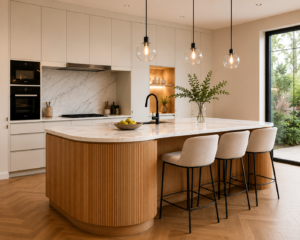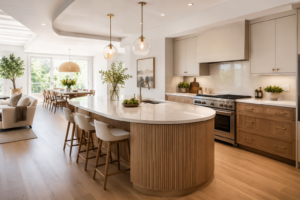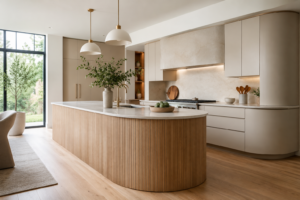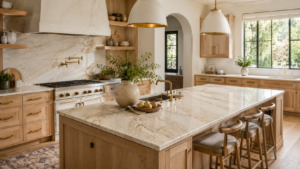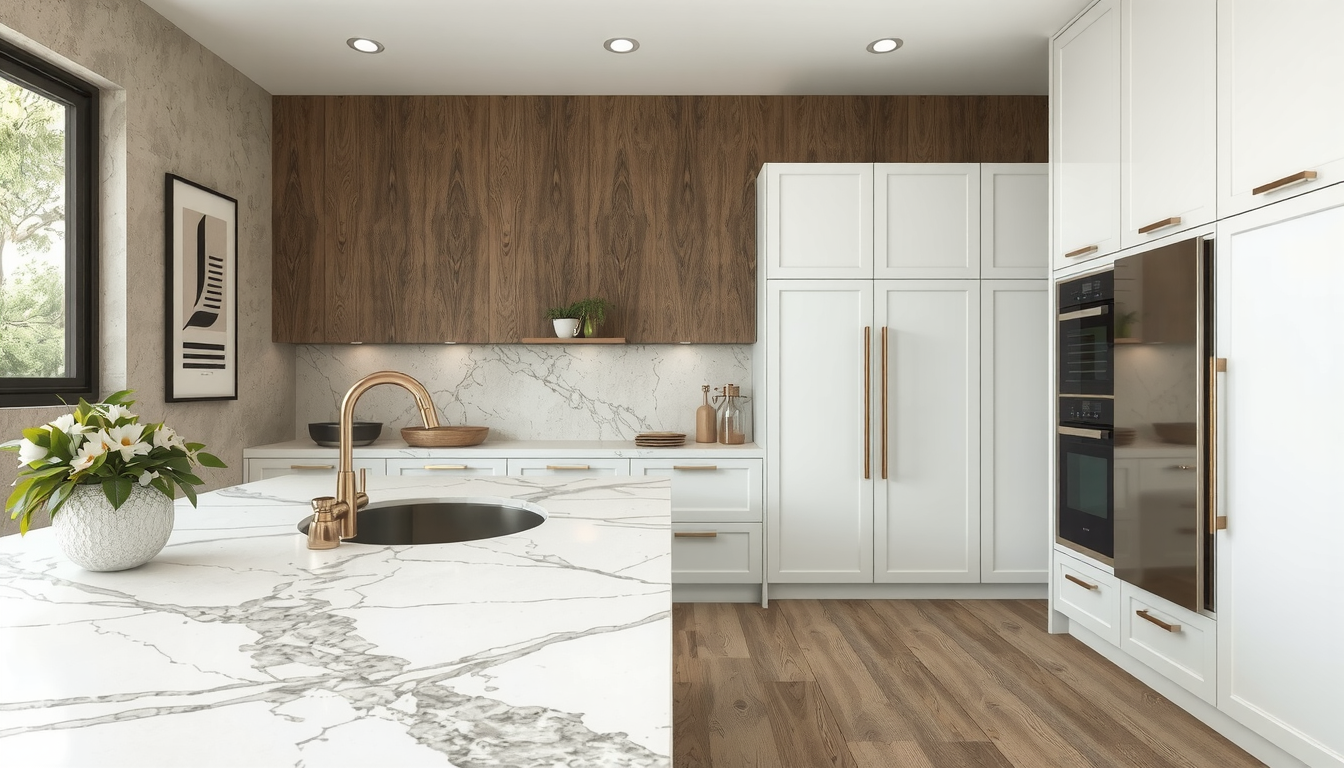
A lot of modern kitchens look clean in photos but feel a little flat in real life. That’s partly why leathered Taj Mahal quartzite has become so popular lately. It softens the sharper edges of modern cabinetry and adds texture without making the space feel busy.
What makes this combination work is the balance. The cabinetry keeps the space clean and structured, while the leathered quartzite adds enough texture to stop the kitchen from feeling overly polished or sterile.
Key Takeaways
- Leathered Taj Mahal quartzite has a soft, matte texture. It cuts down glare and hides fingerprints.
- This stone has a Mohs hardness of 7. This makes it stronger than marble.
- Pair this textured countertop with cabinets that are flat-panel, modern Shaker, or handleless. This gives a modern look.
- Matte finishes usually pair better with leathered quartzite than glossy cabinetry, especially in warmer whites, wood tones, or muted greiges.
- Finish the design with smart backsplashes, hardware, and lighting. This highlights the countertop’s unique finish.
What is Leathered Taj Mahal Quartzite? Understanding its Unique Appeal
Before choosing cabinet colors or finishes, it helps to understand why this particular quartzite works so well in modern kitchens. Leathered Taj Mahal quartzite is a stone found in nature. It is famous for its creamy beige and white tones along with soft, flowing veins. The “leathered” finish refers to the way the stone surface is brushed and textured after fabrication.
The Look and Feel of a Leathered Finish
A leathered finish creates a soft, matte surface. Unlike a stone polished to a high sheen, it doesn’t reflect much light. This would be the main cause of glare. The softer finish gives the kitchen a calmer look compared to high-polish stone.
You still feel a subtle texture when you run your hand across the surface, which is part of why leathered quartzite feels softer and more relaxed than a polished slab. That slight texture is also what gives leathered quartzite more visual depth once natural light hits the surface.
If you’ve only seen polished Taj Mahal before, the leathered finish feels noticeably softer and less reflective in person. You will experience an original and classy feel from leathered finishing.
Durability and Practicality of Taj Mahal Leathered Quartzite
Taj Mahal quartzite isn’t just popular because of the color palette. It also holds up extremely well in everyday kitchens. True quartzite, which is a type of slab used for the Taj Mahal, is about the same as other quartzite with a Mohs hardness score ranging from 6 to 7, which makes it strong and difficult to scratch.
Compared to marble, Taj Mahal quartzite tends to hold up better in busy kitchens, especially when it comes to scratching and everyday wear. It’s also less likely to etch when exposed to acidic ingredients like lemon juice or vinegar.
One practical advantage of the leathered finish is that it hides fingerprints, smudges, and light water spots better than polished stone.
- Softer, low-sheen appearance
- Better at hiding fingerprints and everyday smudges
- More texture and visual depth
- Durable enough for high-use kitchens
The Art of Pairing: Modern Cabinet Styles for Your Textured Countertop
Cabinet style changes the overall feel of the kitchen more than people expect. The idea is to combine the cabinets that are striking with the beautiful textured countertops. Below is a compilation of the best modern cabinet styles that can be paired up with leathered Taj Mahal quartzite.
Flat-Panel or Slab Cabinets: The Minimalist Dream
Flat-panel cabinets are usually the easiest match for leathered Taj Mahal quartzite if you want a clean modern look without too much visual competition. The cleaner cabinet fronts let the movement in the quartzite stand out instead of competing with it.
Because the cabinet fronts stay visually quiet, the texture and veining of the quartzite naturally become the focal point. This combination works especially well in minimalist or European-style kitchens where material texture does most of the visual work.
Modern Shaker Cabinets: A Transitional Touch
Compared to slab cabinets, modern shaker fronts add a little more shadow and detail without making the kitchen feel traditional. It has thinner frames and straight lines. It sits somewhere between traditional shaker cabinetry and fully contemporary slab designs.
Modern shaker cabinets tend to make the kitchen feel warmer and a little less severe, especially when paired with textured quartzite. Modern shaker cabinets usually feel a little more approachable than full slab cabinetry, especially in family kitchens or open-plan spaces. That balance works especially well in transitional kitchens and softer “warm modern” spaces.
Handleless Cabinets: For a Seamless Flow
If you are looking for the cleanest possible option, you should try handleless cabinets. These cabinets work with either integrated channel pulls or push-To-open systems. Without visible hardware interrupting the lines, the kitchen tends to feel quieter visually.
Handleless cabinets can make smaller kitchens feel noticeably less crowded visually. The focus shifts more toward the stone, lighting, and overall material palette. The contrast of the sleek cabinet doors and the leathered quartzite worktops creates a strong design message. This is a fantastic option for compact kitchens. Besides, it suits anyone who desires a truly uninterrupted appearance.
The Right Palette: Cabinet Finishes and Colors for Leathered Taj Mahal
After deciding on a cabinet fashion, moving forward to the finish and color is the next step. This is your opportunity to truly define the character of your kitchen. The leathered Taj Mahal quartzite features warm, neutral tones which blend with a myriad of palettes. Considering the option of custom cabinet finish is vital. Matte kitchen cabinet styles tend to pair well with leathered quartzite.
Some cabinet finishes work more naturally with Taj Mahal quartzite than others. Here are a few combinations designers use most often.
Cabinet Color/Finish | Resulting Aesthetic | Pro Tip |
Matte White/Cream | Bright, airy, serene | Warm whites usually work better than bright blue-toned whites here.Extremely cool whites can make Taj Mahal quartzite read more yellow than it actually is, especially under LED lighting. |
Matte Greige/Taupe | Sophisticated, earthy | This creates a seamless, high-end look. Make sure you have good lighting to keep the space from feeling too flat. |
Natural Wood (White Oak/Walnut) | Warm, organic, textured | White oak and walnut both pull out the warmer movement in Taj Mahal quartzite without overpowering it. |
Matte Black/Charcoal | Bold, dramatic, high-contrast | Use this on a kitchen island or lower cabinets. Matte black can look beautiful with leathered Taj Mahal, but it usually needs either strong natural light or lighter surrounding finishes to keep the space from feeling heavy. |
Deep Green/Navy Blue | Luxurious, moody, elegant | Pair these colors with brushed brass hardware. Deep greens and navy tones usually bring out the warmer veining in Taj Mahal quartzite, especially with softer brass hardware nearby. |
For further ideas, you can see how designers pair different cabinet colors in these inspiring kitchen designs featuring leathered Taj Mahal quartzite.
Pulling It All Together: Essential Design Details
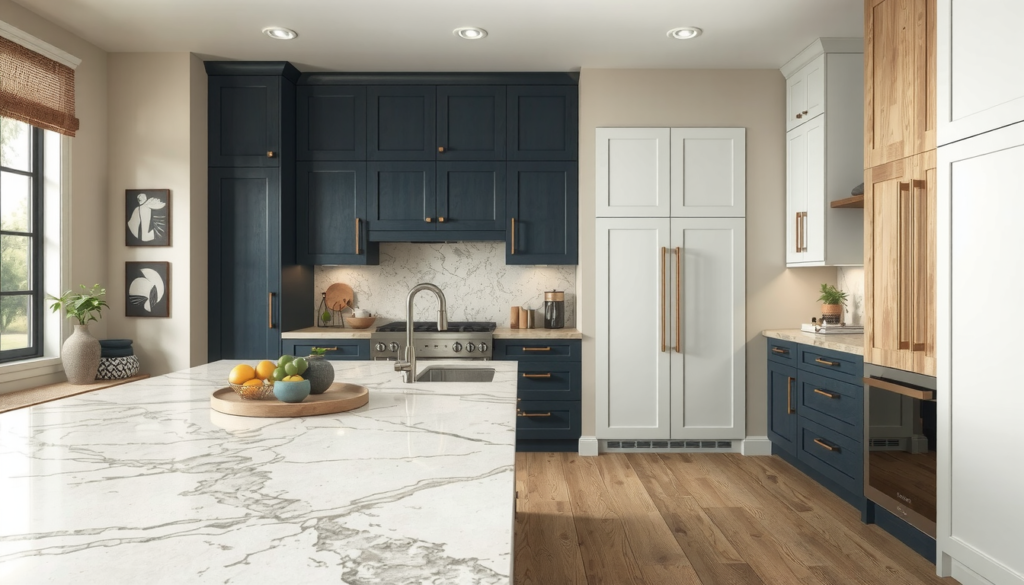
Once the cabinets and quartzite are chosen, the smaller details start to matter a lot more. A few primary items to bear in mind for your leathered taj mahal quartzite kitchen are:
Backsplash Choices
The backsplash is what connects the countertops and the cabinets. A stunning option would be to take the leathered Taj Mahal quartzite all the way up, thus making it a dramatic and seamless design.
Zellige tile also works well here because the imperfect surface keeps the kitchen from feeling too uniform. The handmade ceramic tiles have a slight change in color, which adds warmth and personality to the backsplash. If you need something that will really contrast, a single, solid color glass sheet is a perfect option. Also, a simple plaster finish can be used quite nicely.
Hardware and Fixtures
Hardware changes the overall tone of the kitchen more than most people expect. If you wish to have a matte countertop, we recommend using hardware with a soft, non-reflective finish.
Brushed brass and softer metallic finishes usually feel more cohesive with leathered stone than highly reflective chrome. Softer finishes usually pair better with leathered quartzite because they don’t compete with the texture of the stone.
Lighting is Key
Lighting matters even more with leathered surfaces than polished ones. But, it’s specially crucial to a kitchen with a textured countertop. Under-cabinet lighting makes a bigger difference with leathered quartzite than most people expect. It will reflect over the leathered surface and bring out its distinctive soft texture.
Pendant lighting tends to interact really differently with leathered stone compared to polished slabs. This surface is totally different from a polished one. Instead of reflecting sharp glare, leathered quartzite diffuses light in a softer way. That softer reflection is part of why leathered quartzite feels calmer in person than polished stone.
Maintenance Suggestions for Your Leathered Taj Mahal Quartzite Kitchen
Leathered Taj Mahal quartzite is relatively low-maintenance, but it still benefits from basic stone care. Yet, they require some basic maintenance to maintain their best appearance. One reason homeowners end up liking leathered finishes long term is that they hide fingerprints and light water spots surprisingly well.
Sealing the Countertop and Daily Care
Natural stone has to be properly sealed. By sealing the stone you create a protective barrier that will help to avoid stains. The countertop fabricator is responsible for applying the very first coat of the sealer. This is typically every couple of years.
The daily cleaning process is both easy and quick.
- You can use either a pH-neutral stone cleaner or a mix of mild soap and water.
- It is best to steer clear of abrasive sponges and strong chemical cleaners like bleach or ammonia.
- Make it a point to wipe up spills immediately. Particularly, the acidic spills like wine, coffee, or lemon juice.
Frequently Asked Questions (FAQ)
Here are answers to some common questions about using leathered Taj Mahal quartzite in your kitchen.
Does leathered Taj Mahal quartzite stain easily?
Not usually. Once it’s properly sealed, it handles everyday spills pretty well. The leathered texture also hides light water marks and fingerprints better than polished finishes. Like most natural stone, it’s still better not to leave acidic spills sitting for hours.
Is a leathered finish more expensive than polished?
The cost can be similar or slightly higher for a leathered finish. This is because it is an extra step that uses special diamond-tipped brushes. Prices vary between fabricators. So it’s always a good idea to get quotes for both finishes. Some examples of slab pricing show that costs can vary based on finish and supplier.
What’s the best way to clean a leathered quartzite countertop?
The best way to clean your countertop is with a soft cloth and a pH-neutral cleaner made for natural stone. A simple solution of mild dish soap and warm water also works well. Do not use abrasive scrubbers. They can wear down the sealer.
Can I use leathered Taj Mahal quartzite for a waterfall island?
Yes, absolutely. A waterfall island with leathered Taj Mahal quartzite is a beautiful design choice. It showcases the stone’s texture and veining as it flows from the horizontal top down the vertical sides. This creates a dramatic and modern look.
What backsplash works best with this combination?
For a seamless look, using the same leathered Taj Mahal quartzite for the backsplash is a great option. For textural contrast that still feels warm, handmade Zellige or simple subway tiles are popular. For a minimalist approach, a smooth plaster finish or back-painted glass keeps the focus on the textured countertops with cabinets.