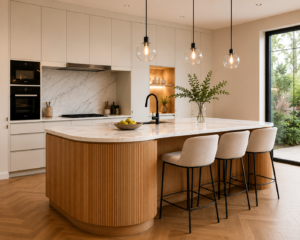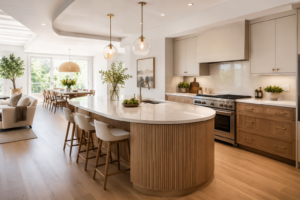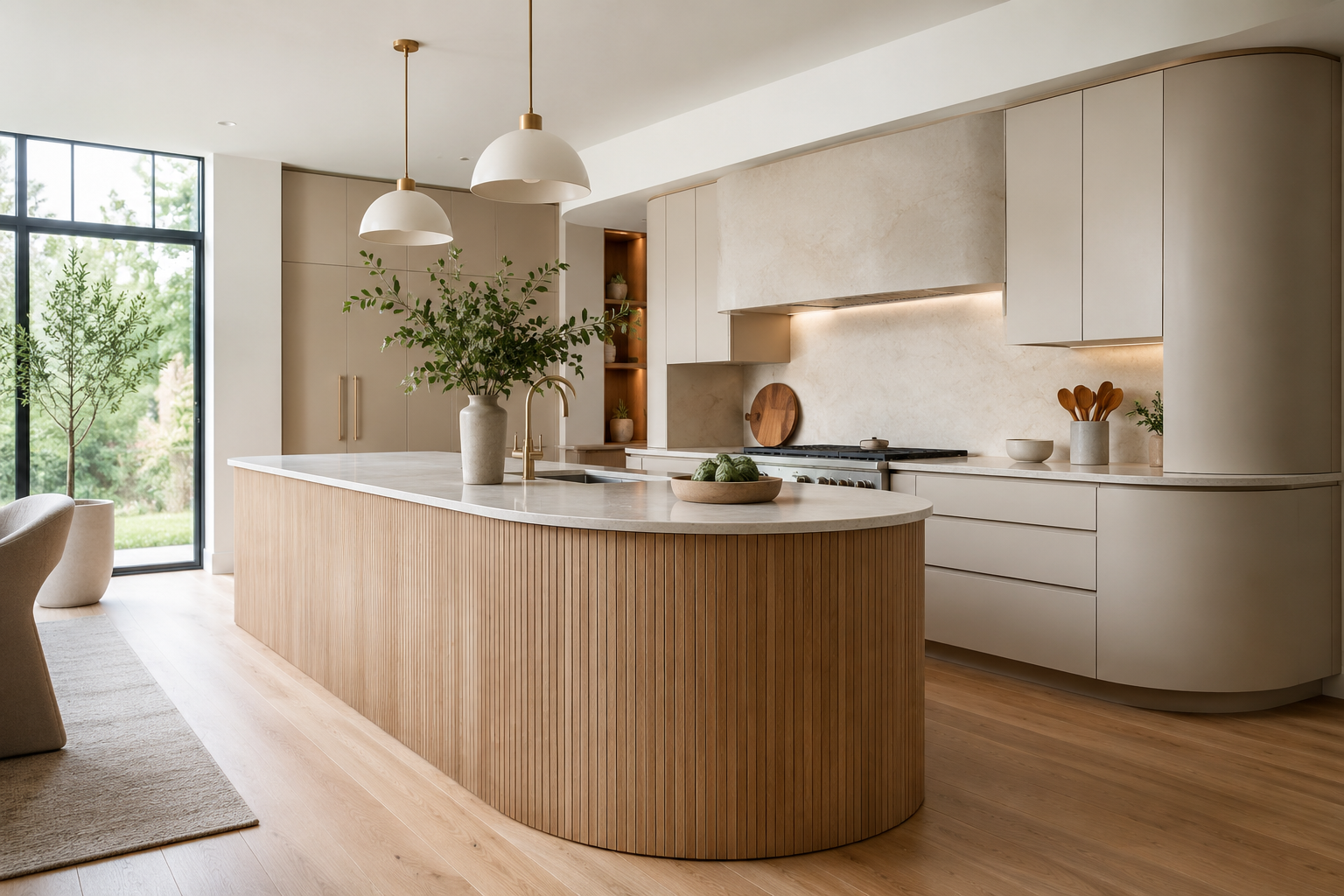
A curved cabinet can make an exposed island end, vanity front, or built-in cabinet look more planned than a standard flat cabinet. Instead of stopping with a hard edge, the cabinet follows the shape of the space more carefully.
It is not only a style detail. A true curved cabinet uses a continuous bent door, panel, or cabinet face, so the curve has to be considered in the structure, opening method, finish, and storage layout.
Image alt: Modern curved cabinet design with rounded edges in a contemporary kitchen interior.
Key Takeaways
- Curved cabinets are different from rounded corner cabinets. A true curved cabinet has a door, panel, or face that follows one continuous curve.
- Use curved cabinetry where the edge is exposed, frequently passed by, or part of a visible design feature.
- Wood, MDF, veneer, and curved glass can all work, but each material has different limits for radius, finish, strength, and visible seams.
- Confirm the radius, material, hardware, storage layout, shop drawings, lead time, and installation method before production starts.
What Exactly Are Curved Cabinets?
A curved cabinet has a smooth, continuous arc built into the door, side panel, island end, vanity front, or full cabinet face. It is different from a cabinet that only has softened or rounded corners. In a true curved cabinet, the curve belongs to the cabinet form itself.
This shape is useful where a flat cabinet would feel too heavy, too abrupt, or too close to a walkway. It can remove a hard island corner, make a vanity project less into the room, or help built-in storage meet an open area without a hard stop.
The curve needs to be decided while the layout is still being developed, not added after the cabinet size and surrounding clearances are already fixed.
Curved Cabinets vs. Rounded Corner Cabinets
In a curved cabinet, the door, panel, or face follows one continuous bend. In a rounded corner cabinet, the main cabinet usually stays flat, with a rounded end or corner module added to remove the sharp edge.
Feature | Curved Cabinets | Rounded Corner Cabinets |
Construction | Built with a continuous curved door, panel, or face | Usually combines standard flat cabinet parts with a rounded end or corner section |
Visual effect | Continuous, cleaner from the side view, and less like an added corner piece | Removes the sharp corner, but seams or transition lines may still show |
Complexity | Requires more planning, shaping, and fabrication skill | Easier to produce because more of the cabinet uses standard construction |
Cost | Usually higher due to custom shaping, materials, and labor | Usually lower than a true curved cabinet, but higher than a standard square cabinet |
Best use | Kitchen islands, vanities, custom bars, media units, and built-ins where the curve is part of the design | Cabinet ends, traffic corners, and areas where the goal is mainly to remove a sharp edge |
Where Curved Cabinetry Works Best
Curved cabinetry makes the most sense where people see or pass the cabinet edge often. Common locations include island ends, exposed cabinet runs, bathroom vanities, custom bars, media units, and built-in storage walls.
Kitchen Islands
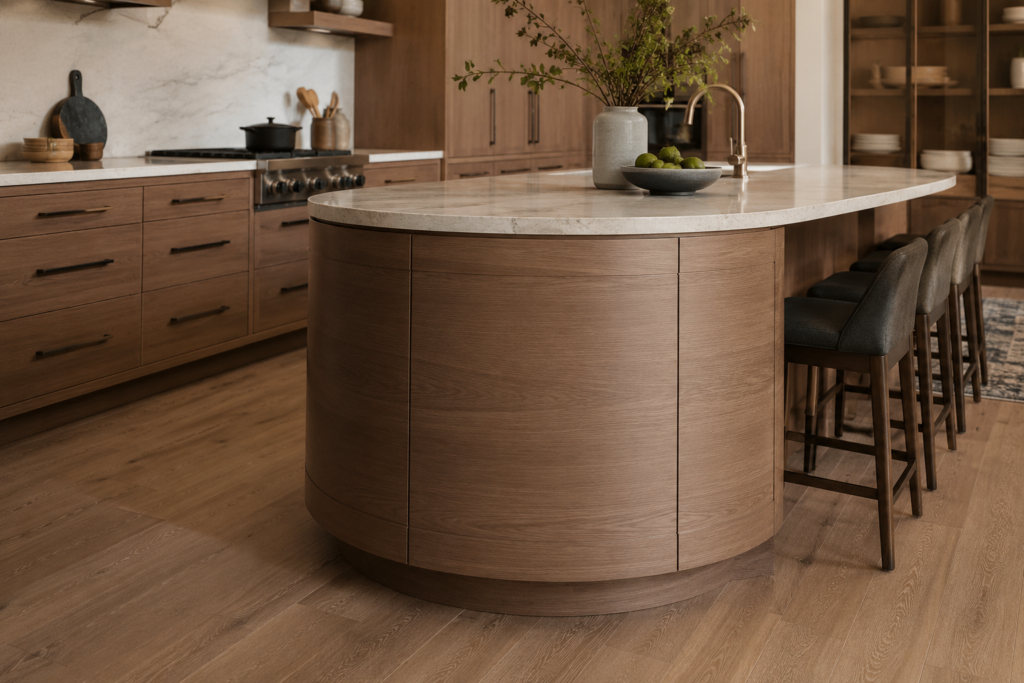
Kitchen islands are one of the most common places to use curved cabinets. On an island, the curved end is usually about circulation and side view. It removes the hard corner where people pass by and keeps the seating side from looking like a plain box.
End of Cabinet Runs
At the end of a long cabinet run, a curve can help the cabinet meet a doorway, hallway, or open living area without a hard vertical stop. This matters in kitchens, wardrobes, and living room built-ins where the cabinet end is exposed from the side.
Bathroom Vanities
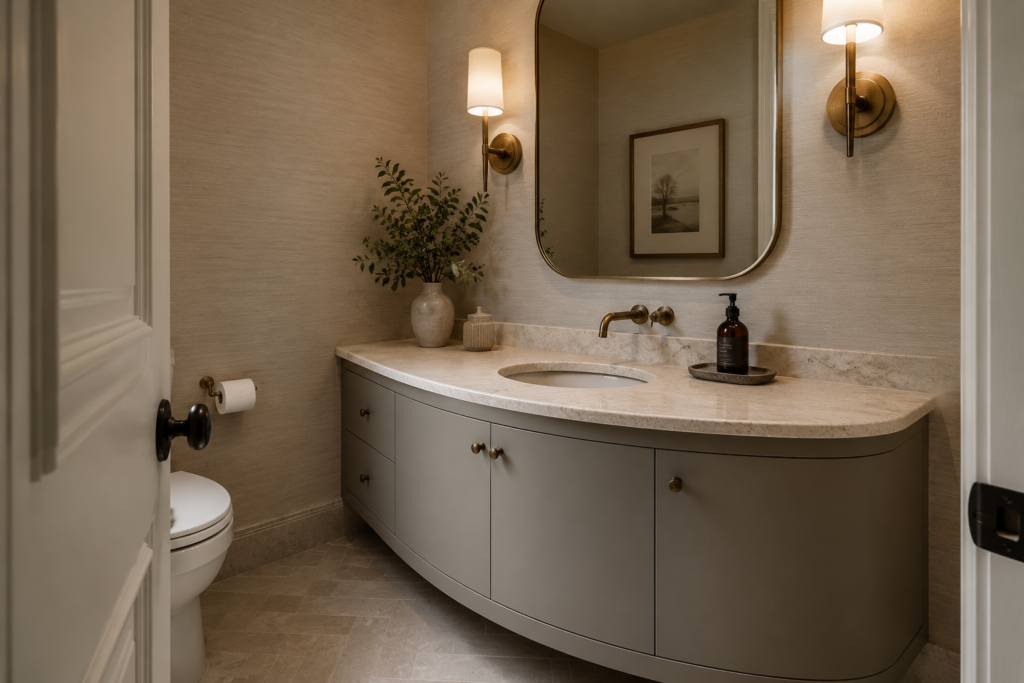
A curved vanity can work well in powder rooms or narrow bathrooms where the front edge sits close to a door, shower entry, or walking path. The curve reduces the block-like projection of a standard vanity and removes a sharp corner in a tight area.
Custom Bars and Media Units
Custom bars and media units often have more visible front panels than standard storage cabinets. In high-end cabinetry projects, curved bar fronts are often used to make a built-in area feel less flat; Wood-Mode’s Cunningham Road Bar, for example, features a long wall of curving cabinetry in a walnut finish. A curved media unit can also follow the shape of a screen wall, speaker area, or display section.
Office and Library Built-ins
In offices and libraries, curved shelving can break up a long flat wall of storage and create a defined area for books, art, or display pieces. Shelf depth, access, and usable storage still need to be checked, especially if the curve affects how far items can sit back.
The Anatomy of a Curve: Materials
For curved cabinets, material choice is not only about appearance. The panel has to bend cleanly, hold the radius, and stay stable after installation.
Plywood and Bending Plywood
Plywood is often used for curved cabinetry because it is stable and easier to shape than many solid boards. Thin plywood layers can be pressed into a mold so the panel holds a consistent arc.
Bending plywood is more flexible than standard plywood, so it is often used for island ends, curved side panels, and custom built-ins. It can sit under paint, veneer, or other applied finishes, depending on the design. For wood-based curved cabinet projects, Livranger focuses on custom sizing, material selection, finish details, and production drawings before the cabinet moves into fabrication.
Solid Wood
Solid wood is usually chosen when the natural grain is part of the design and the cabinet needs a more furniture-like finish. Oak, ash, and beech are often used because they tend to bend better than many other woods.
Solid wood curves require careful material selection and skilled bending. If the process is rushed or the wood is not suited to the radius, it may crack, spring back, or move over time.
MDF
MDF is often used for painted curved cabinets. It has a smooth surface, stays relatively stable, and is usually more affordable than solid wood. It is not the right choice for exposed natural grain, but it can work well for painted vanities, cabinet fronts, and decorative curved panels.
For curved work, MDF is often shaped with kerf cuts on the back side. If the cuts are too deep, too shallow, or uneven, the curve may look wavy or lose strength.
Glass for Curved Cabinet Designs
Glass can be used as part of a curved cabinet when the design needs a lighter display area, such as a bar cabinet, wardrobe section, or decorative storage unit. It is usually planned together with the wood frame, door structure, and opening method.
The radius, thickness, edge treatment, and frame support should be confirmed before production, because small changes are difficult after curved glass is formed.
The Craftsmanship Behind the Curve
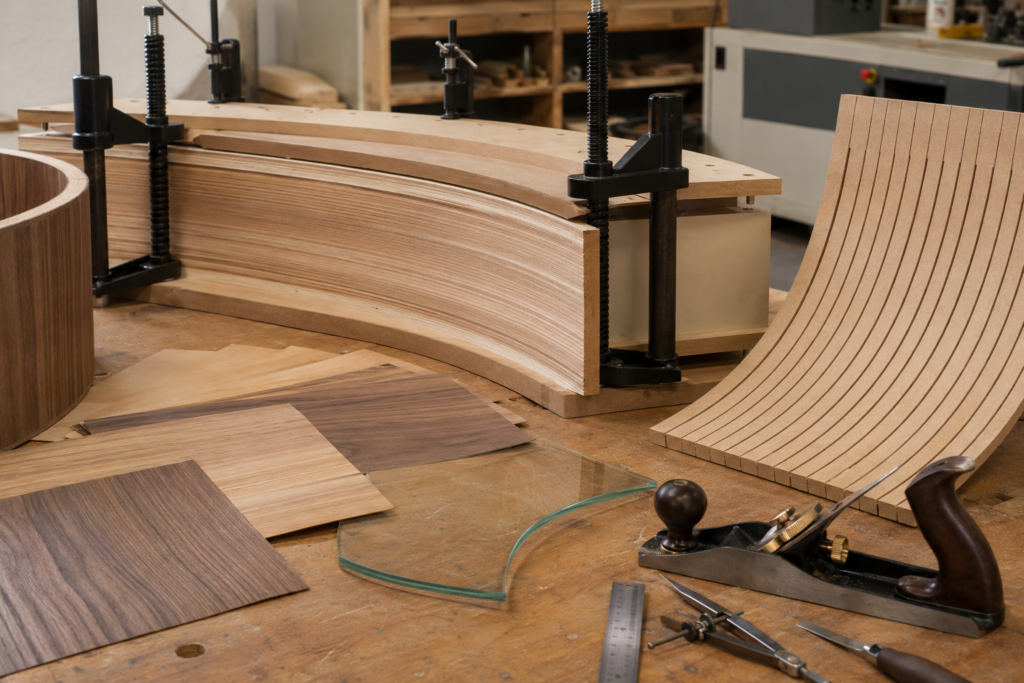
A curved cabinet may look simple once it is installed, but it takes more setup than a standard cabinet box. The radius needs to be fixed early, and the maker may need a mold, jig, or pressing form before the panel can be shaped.
Lamination and Form Pressing
For many wood-based curved panels, lamination is the practical choice. Thin layers of plywood or veneer are glued together and pressed into a curved mold until the panel holds its shape.
You will often see it on cabinet doors, side panels, island ends, and built-ins where the curve needs to stay stable.
Steam Bending
Steam bending is used for solid wood when visible grain matters. The wood is softened with steam, bent around a form, and held in place while it dries.
If the wood is bent too tightly or released too early, it may crack, spring back, or lose the intended curve.
Kerf Bending
Kerf bending is often used with MDF and some plywood panels. Grooves are cut into the back of the panel so it can flex into a curve while the front face stays smooth.
It is usually used for painted curved cabinets where the back side will not be exposed. Tight curves, heavy-use areas, or visible backs may need a stronger construction method.
Your Custom Curved Cabinet Checklist
Custom curved cabinets need more detail than standard cabinetry. Problems often start before production, especially when the radius is unclear, the hardware is chosen too late, or the interior is planned like a normal square cabinet.
Exact Radius and Arc
Confirm the exact radius on the floor plan. Is it a gentle arc, a tighter curve, or close to a half-circle? The cabinetmaker needs this measurement for the mold, door, frame, shelves, and curved panels.
A rendering can show the design direction, but it should not replace production dimensions.
Material and Construction Method
Ask how the curve will be made. For wood-based curved cabinets, common options include laminated plywood, bending plywood, solid wood, MDF, or veneer. For display-focused designs, curved glass may also be used in doors or front sections.
Match the material to the finish. Painted curves, natural wood grain, veneer surfaces, and glass fronts do not use the same construction details.
Finish and Seam Details
For painted cabinets, check how the curved face, edges, and back side will be finished. For wood or veneer, confirm the grain direction across the curve. For glass sections, check the edge treatment, frame connection, and visible joint lines.
Ask for a material sample or finish sample if the curve will sit in a highly visible area or under strong lighting.
Hardware Specifications
Standard hinges may not work well on curved doors. Depending on the design, the cabinet may need special hinges, sliding hardware, touch-latch systems, or custom pulls.
Confirm the hinge position, opening angle, and handle style before production. Even a small hardware change can affect the door structure or available clearance.
Internal Storage and Accessibility
A curved exterior changes the inside space. Some areas may become deeper, narrower, or harder to reach than they would be in a standard cabinet box.
For daily-use cabinets, check whether the storage needs curved shelves, pull-outs, rotating shelves, or custom dividers. For display cabinets, check how easy it will be to clean the glass and reach the back area.
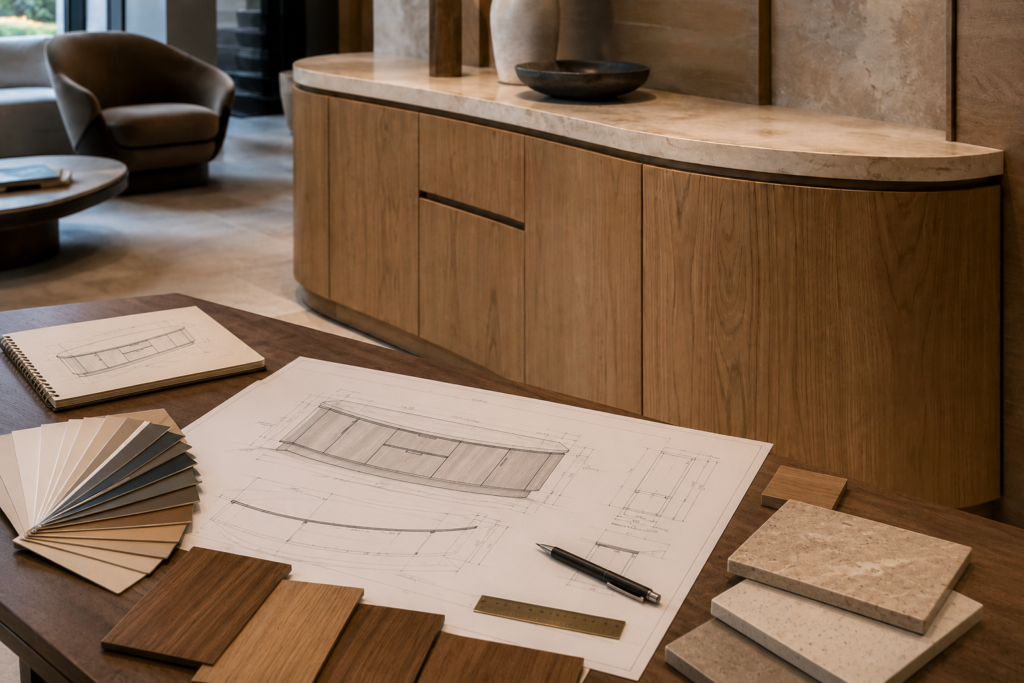
Shop Drawing Approval
Shop drawings should show the actual dimensions, radius, sections, door swing, material thickness, hardware position, glass details, and installation points.
When working with a custom cabinet supplier such as Livranger, share the layout, dimensions, material, color, and finish requirements before production drawings are approved. After the curved panel, shaped door, or curved glass piece is formed, even a small change can affect the frame, finish, or fit on site.
Lead Time and Installation Plan
Curved cabinets may need extra production time for molds, pressing, bending, glass shaping, finish testing, or hardware adjustment.
Confirm the timeline, site measurements, wall and floor conditions, countertop connection, and installation method before the order moves into production.
Final Thoughts
A curved cabinet should be decided while the layout, radius, material, and hardware are still being worked out. Once the curved panel, shaped door, or curved glass piece is made, even a small change can affect the frame, finish, opening clearance, or fit on site.